

Salesforce AI Cloud: Enterprise AI Platform Explained
Salesforce AI Cloud is an enterprise-grade artificial intelligence platform designed to embed generative AI, automation, and real-time intelligence directly into Salesforce workflows. Built on top of Salesforce CRM, Data Cloud, and the Salesforce Trust Layer, it allows organizations to analyze data, generate insights, and execute actions securely at scale.
Rather than acting as a standalone AI assistant, Salesforce AI Cloud functions as a foundational layer inside the Salesforce ecosystem. As a result, AI becomes part of everyday business operations — from sales and service to marketing, commerce, and development. For enterprises and ISVs, this shift marks a new stage in how CRM platforms deliver value through intelligence.
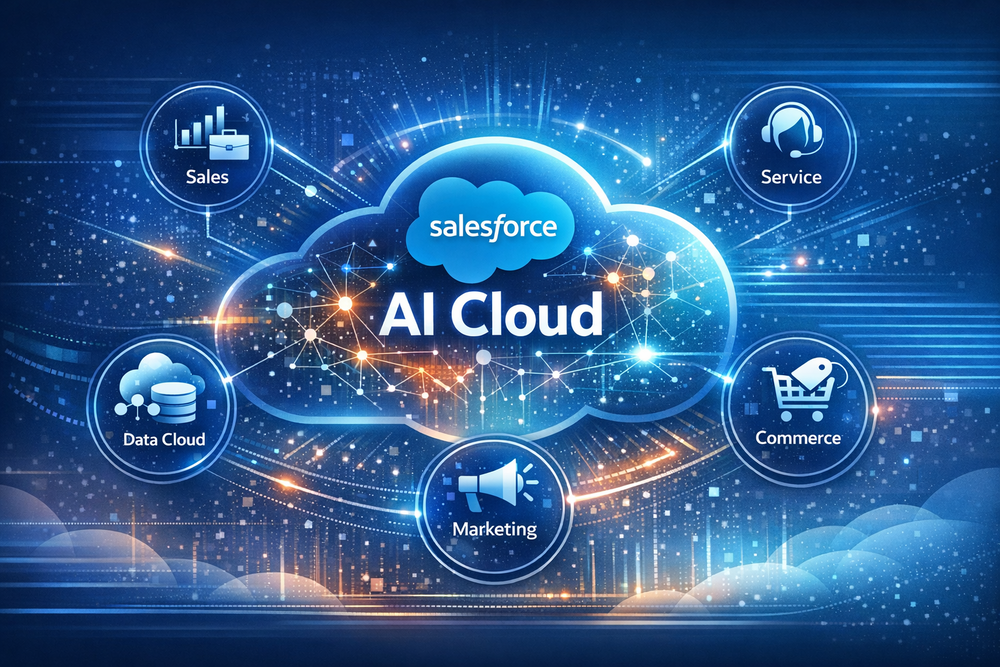
What Is Salesforce AI Cloud?
Salesforce AI Cloud is a unified AI platform that combines CRM data, Data Cloud, large language models (LLMs), and automation tools into a single system. Unlike external AI tools, it operates natively within Salesforce, ensuring that every response and recommendation is grounded in real business context.
In practice, this means AI understands customer history, active opportunities, service interactions, and behavioral signals before producing output. As a result, organizations can rely on AI-generated content and actions with greater confidence.
For large Salesforce environments, however, AI Cloud is not simply a feature to turn on. It requires thoughtful architecture, data readiness, and governance. This is where experienced Salesforce partners such as Success Craft play a key role in helping companies adopt AI in a controlled and scalable way.
How Salesforce AI Cloud Works
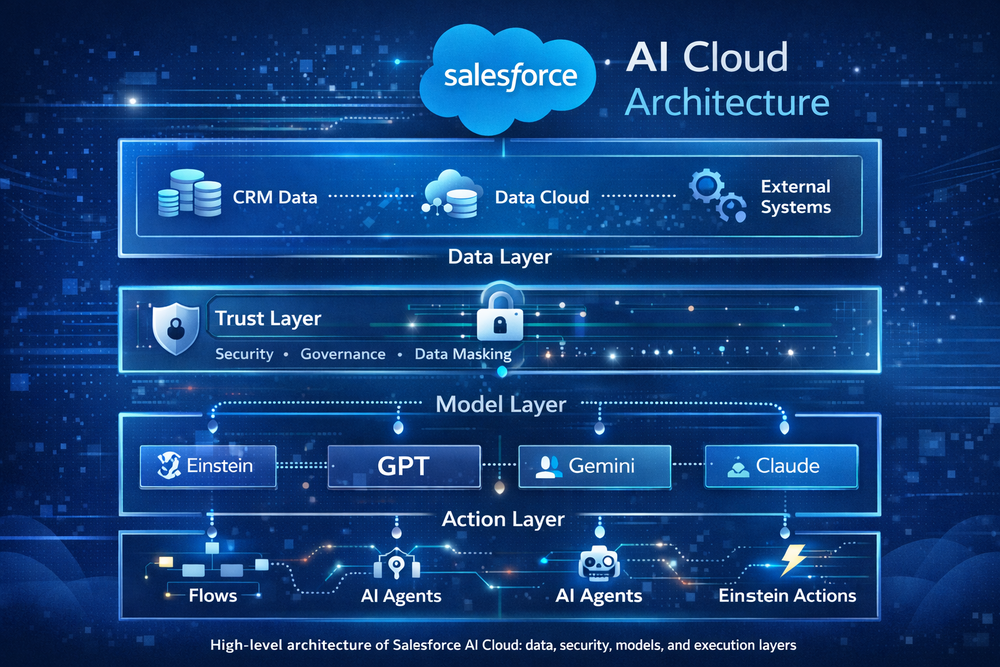
Salesforce AI Cloud is built as a layered architecture that ensures accuracy, security, and scalability:
- Data Layer — combines CRM data with Data Cloud to provide real-time, unified customer profiles.
- Trust Layer — enforces security, governance, data masking, grounding, and audit controls.
- Model Layer — routes requests between Einstein, GPT, Gemini, and Claude based on context and compliance.
- Action Layer — executes AI-driven actions through Flows, Einstein Actions, and AI Agents.
Salesforce AI Cloud is built as a layered architecture. Each layer contributes to accuracy, security, and operational reliability.
Data Layer: CRM and Data Cloud
The Data Layer forms the foundation of Salesforce AI Cloud. Core CRM objects provide structured operational data, while Data Cloud unifies additional signals from marketing platforms, commerce systems, websites, and external applications.
By creating real-time, unified customer profiles, Data Cloud ensures that AI outputs are based on complete and up-to-date information. Consequently, AI recommendations become more relevant and actionable.
In complex enterprise landscapes, data is often fragmented across systems. Therefore, preparing and integrating data correctly is a critical success factor. Success Craft supports organizations in designing data architectures and integrations that make AI reliable rather than experimental.
Trust Layer: Security and AI Governance
Security remains one of the biggest concerns in enterprise AI adoption. Salesforce addresses this challenge through the Trust Layer, which acts as a secure interface between business data and AI models.
The Trust Layer enforces data masking, access control, grounding, zero data retention for external models, and full audit logging. As a result, sensitive information is protected even when generative AI is used across teams.
From an enterprise perspective, governance is just as important as functionality. Without clear policies and controls, AI can amplify existing process issues. This is why defining AI governance early — an area where Success Craft provides strategic guidance — significantly reduces risk during adoption.
Model Layer: Einstein, GPT, Gemini, and Claude
Salesforce AI Cloud supports multiple large language models, including Salesforce Einstein models and external providers such as OpenAI GPT, Google Gemini, and Anthropic Claude. Instead of forcing organizations to choose a single model, Salesforce uses intelligent model routing.
Model routing selects the most appropriate model for each request based on factors such as data sensitivity, cost, performance, and expected output quality. Consequently, organizations can balance innovation with control, without managing models manually.
This flexibility is especially valuable for enterprises that must meet strict compliance and cost-management requirements.
Action Layer: From Insights to Execution
Many AI platforms stop at insights. Salesforce AI Cloud goes further by enabling execution.
Through Einstein Actions, Salesforce Flows, and AI Agents, AI Cloud can update records, generate summaries, trigger workflows, and orchestrate multi-step processes. AI Agents, in particular, represent a major evolution in Salesforce automation. They can interpret goals, break them into steps, and execute actions autonomously within defined governance rules.
Designing these workflows requires deep understanding of Salesforce architecture, especially in multi-org environments. As a result, organizations often rely on partners like Success Craft to implement AI-driven automation safely and at scale.
Key Features of Salesforce AI Cloud
Salesforce AI Cloud brings together several components that operate as a single ecosystem rather than isolated tools.
Einstein GPT enables context-aware content generation, summaries, and recommendations across Salesforce Clouds. Because it is grounded in CRM data, the output aligns with real customer and business context.
Prompt Builder allows organizations to create structured, reusable prompts tied directly to Salesforce objects and fields. This ensures consistency, reduces manual prompt writing, and supports governance.
AI Agents introduce autonomous execution into Salesforce processes. Unlike traditional rule-based automation, Agents can adapt to context and handle more complex scenarios.
Finally, deep integration with Data Cloud strengthens all AI capabilities by providing real-time customer profiles and behavioral insights.
Business Benefits of Salesforce AI Cloud
Salesforce AI Cloud delivers measurable value across multiple business functions.
Key business benefits of Salesforce AI Cloud include:
- improved sales productivity through AI-generated insights and follow-ups;
- faster and more consistent customer service with AI-assisted case resolution;
- personalized marketing powered by real-time data and AI-driven segmentation;
- reduced operational costs through intelligent automation;
- enterprise-grade security and compliance through the Trust Layer.
For sales teams, it reduces administrative work while improving decision-making. Sellers can focus on relationships and strategy while AI handles follow-ups, summaries, and insights.
In customer service, AI Cloud accelerates case resolution by summarizing interactions, classifying requests, and supporting automated workflows. As a result, response times improve and service quality becomes more consistent.
Marketing teams benefit from personalization at scale. AI-driven segmentation and content generation allow campaigns to adapt dynamically to customer behavior.
Across the organization, AI Cloud helps reduce operational costs by automating repetitive tasks, while maintaining enterprise-grade security and compliance.
Salesforce AI Cloud Use Cases
Salesforce AI Cloud is already applied across multiple Salesforce Clouds.
In Sales Cloud, AI supports pipeline analysis, opportunity insights, and intelligent follow-ups.
In Service Cloud, it enables case summarization, routing, and AI-driven resolution workflows.
In Marketing and Commerce, AI powers personalized journeys, recommendations, and adaptive campaigns.
On the Salesforce Platform, developers use AI to accelerate Apex development, documentation, and automation design.
Each of these use cases benefits from strong data foundations and consistent governance.
Challenges of Adopting Salesforce AI Cloud
Despite its capabilities, Salesforce AI Cloud is not a plug-and-play solution. Organizations often face challenges related to data quality, governance, cost control, and multi-org complexity.
Poor data quality reduces AI accuracy. Lack of governance increases operational risk. In large Salesforce landscapes, inconsistent configurations can lead to fragmented AI behavior.
Addressing these challenges early — ideally with the support of an experienced Salesforce partner — significantly improves long-term ROI.
How Success Craft Helps Implement Salesforce AI Cloud
Success Craft helps enterprises and ISVs adopt Salesforce AI Cloud in a structured and scalable way.
The team supports AI architecture and governance design, ensuring that Trust Layer policies, access controls, and compliance requirements are clearly defined. Success Craft also helps organizations prepare their data foundations through Data Cloud configuration and complex integrations.
For advanced scenarios, Success Craft designs and implements AI Agents and intelligent workflows tailored to real business processes. In addition, ISVs benefit from expertise in embedding AI features into managed packages and scaling them across customer orgs.
In multi-org environments, Success Craft helps standardize AI behavior, deployment strategies, and governance models — enabling consistent AI adoption across the enterprise.
Best Practices for Salesforce AI Cloud Adoption
Successful adoption starts with a clear strategy. Organizations should begin with pilot use cases, focus on data readiness, and define governance before scaling.
Measuring business impact and iterating gradually helps ensure sustainable results. Working with a specialized Salesforce partner further accelerates adoption and reduces risk.
Conclusion
Salesforce AI Cloud is transforming how organizations use AI within CRM. By combining data, security, intelligence, and automation into a single platform, it enables enterprises to work more efficiently and deliver better customer experiences.
However, technology alone is not enough. Architecture, governance, and execution determine success. With the right approach and the support of an experienced partner like Success Craft, Salesforce AI Cloud becomes a powerful competitive advantage.
What is Salesforce AI Cloud?
Salesforce AI Cloud is an enterprise AI platform that combines Data Cloud, Trust Layer, LLMs, and automation to enhance Salesforce workflows.
Is Salesforce AI Cloud secure?
Yes. Salesforce uses the Trust Layer to ensure data masking, grounding, zero data retention, and full auditability.
What can Salesforce AI Cloud automate?
Sales, service, marketing, commerce, and platform workflows, including multi-step processes through AI Agents.
How can Success Craft help with Salesforce AI Cloud?
Success Craft provides architecture, governance, data integration, AI Agent design, and enterprise-scale implementation support.
What is the difference between Salesforce AI Cloud and Einstein GPT?
Salesforce AI Cloud is the full AI platform that includes data, security, models, and automation. Einstein GPT is one of its components, focused on generative AI for CRM use cases such as content creation and summaries.
Do companies need Data Cloud to use Salesforce AI Cloud?
Data Cloud is not mandatory, but it significantly improves AI accuracy by providing unified, real-time customer profiles. For enterprise use cases, Data Cloud is strongly recommended.