

Salesforce AI Agents What They Are and How to Use Them
Salesforce AI Agents are a new generation of intelligent automation designed to execute business tasks autonomously inside Salesforce. Unlike traditional rule-based automation, these solutions can understand context, reason about goals, and perform multi-step actions while respecting enterprise security and governance requirements.
As part of Salesforce AI Cloud, Salesforce Agents represent a shift from static workflows to goal-driven execution. For enterprises and ISVs operating complex Salesforce environments, this approach enables higher productivity without losing control over data, processes, or compliance.
What Are Salesforce AI Agents
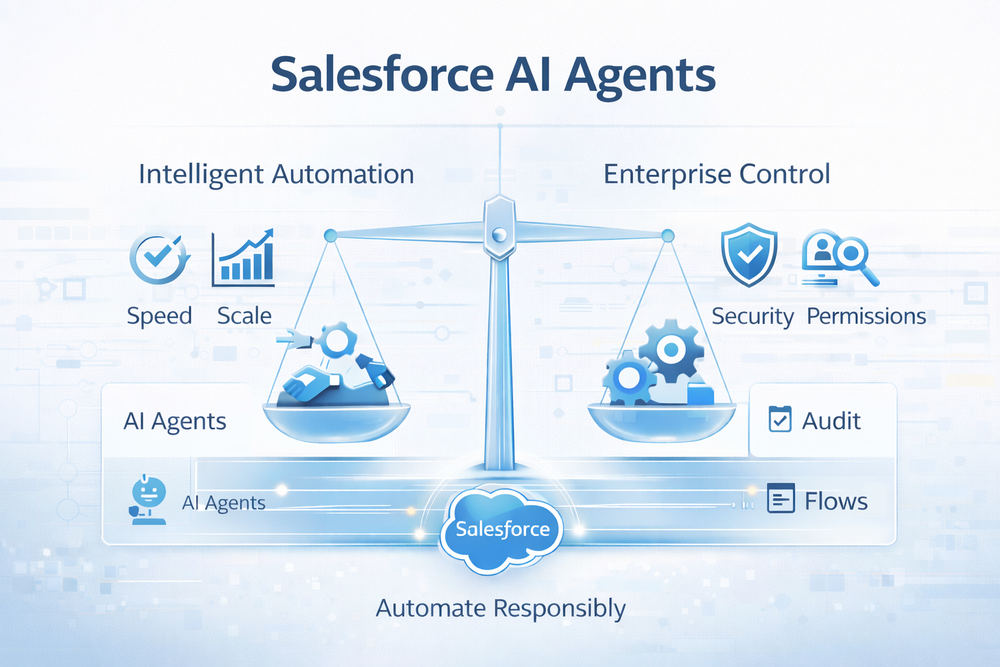
Salesforce Agents are autonomous AI-driven components that act on behalf of users within the Salesforce platform. Instead of following predefined rules, these agents interpret intent, analyze business context, and decide which actions are required to achieve a specific goal.
They work directly with CRM data, Data Cloud profiles, user permissions, and AI models. As a result, Salesforce Agents can operate safely inside existing Salesforce governance frameworks while reducing the manual effort required from teams.
How Work
Salesforce Agents follow a structured execution model that combines intelligence with control. Rather than acting independently of the platform, they operate entirely within Salesforce boundaries.
They work through several key layers:
- Context and data — CRM records, Data Cloud profiles, and user permissions provide real-time business context.
- Reasoning and decision logic — AI models evaluate goals and determine the best sequence of actions.
- Actions and execution — Agents trigger Flows, Apex actions, and record updates.
Because Salesforce Agents work inside Salesforce, every action is logged, auditable, and aligned with security policies.
Salesforce AI Agents Compared to Flows and Einstein GPT
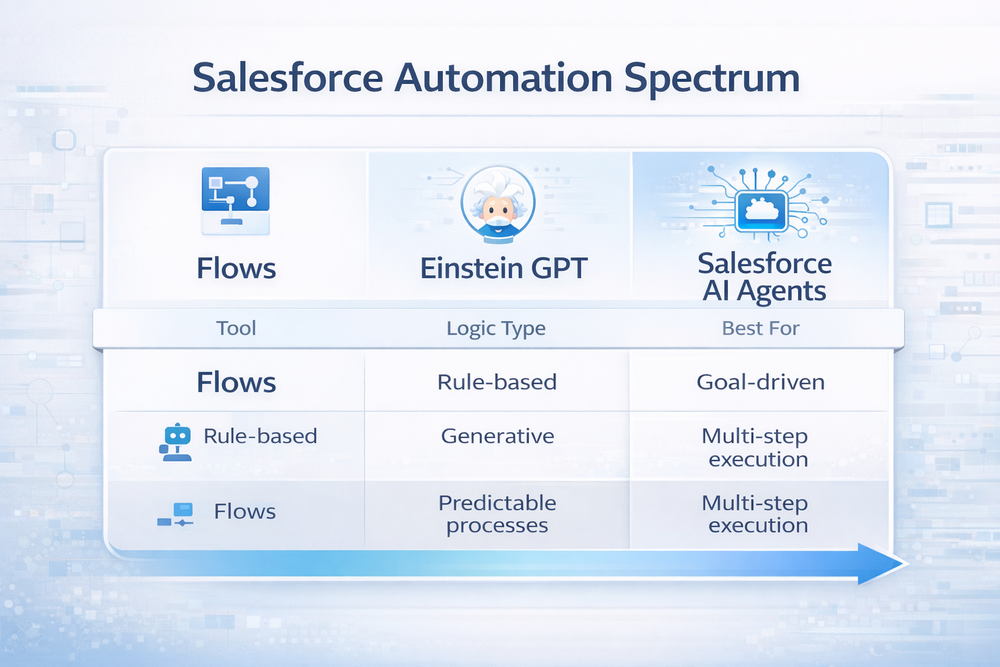
Salesforce Flows remain essential for deterministic automation where logic is predictable and well defined. Einstein GPT focuses on content generation, summaries, and AI-assisted insights.
Salesforce Agents address a different category of problems. They are designed for scenarios where the goal is clear, but the path to achieving it may vary depending on context. Instead of replacing Flows or Einstein GPT, these tools extend them by introducing reasoning and adaptive execution.
This layered automation strategy allows enterprises to apply the right level of intelligence to each process.
Key Use Cases
Salesforce Agents are particularly effective in enterprise scenarios that require scale, flexibility, and consistency.
Common use cases include:
- sales follow-ups, opportunity updates, and activity summaries
- case triage and resolution assistance in Service Cloud
- personalized customer interactions across multiple channels
- administrative and operational support for Salesforce teams
In these scenarios, agent-based automation reduces repetitive work while maintaining process reliability.
Benefits of Salesforce AI Agents
One of the primary benefits of Salesforce Agents is their ability to reduce manual effort across complex workflows. By automating multi-step tasks, teams can move faster and focus on higher-value activities.
They also improve consistency by executing actions according to defined goals and governance rules. As organizations scale, Salesforce Agents provide a more sustainable automation model than manual processes or rigid workflows.
Limitations and Risks
Despite their advantages, Salesforce Agents are not a universal solution. Their effectiveness depends heavily on data quality, governance, and monitoring.
Poor or incomplete data can lead to inaccurate decisions. In addition, without clearly defined boundaries, these agents may behave inconsistently across environments. Cost management and explainability are also important considerations, especially in large enterprise deployments.
For these reasons, Salesforce Agents should be introduced gradually and evaluated continuously.
Best Practices for Implementing
Successful adoption of Salesforce Agents requires a disciplined approach:
- start with narrow, well-defined use cases
- combine AI agents with existing Flows rather than replacing them
- define permissions, guardrails, and governance early
- monitor outcomes and iterate based on real results
Following these practices helps organizations build trust in AI-driven automation.
How Success Craft Helps Implement Salesforce AI Agents
Success Craft helps enterprises and ISVs design, implement, and scale Salesforce Agents in a secure and controlled way. The team supports AI architecture and governance design to ensure alignment with security, compliance, and business objectives.
In addition, Success Craft integrates intelligent agents with Flows, Apex, and Data Cloud to create end-to-end workflows. For organizations operating multiple Salesforce orgs or building managed packages, Success Craft provides strategies for standardizing automation behavior at scale.
When Should You Use Salesforce AI Agents
Salesforce Agents are most effective when tasks involve variability, context awareness, and multi-step execution. They are well suited for processes where traditional automation becomes too rigid or manual intervention slows progress.
However, for simple and predictable logic, Flows or rule-based automation remain the better choice. Selecting the right tool ensures long-term success.
Conclusion
Salesforce AI Agents represent the next evolution of automation within Salesforce. By combining reasoning, context, and execution, they enable enterprises to automate complex workflows more intelligently.
With the right architecture and governance, Salesforce Agents can deliver significant productivity gains. Supported by an experienced Salesforce partner like Success Craft, organizations can adopt AI-driven automation with confidence and scale.
What are Salesforce AI Agents?
Salesforce AI Agents are autonomous components that execute tasks inside Salesforce using AI-driven reasoning and real-time business context.
How do Salesforce AI Agents work?
They combine CRM data, Data Cloud context, AI models, and Salesforce automation tools to perform multi-step actions securely.
How are Salesforce AI Agents different from Salesforce Flows?
Flows follow predefined rules, while Salesforce AI Agents execute goals dynamically based on context.
Are Salesforce AI Agents secure?
Yes. Salesforce AI Agents operate within Salesforce security, permissions, audit logs, and governance frameworks.
What are common use cases for Salesforce AI Agents?
Sales follow-ups, case handling, personalization, and administrative automation.
How can Success Craft help implement Salesforce AI Agents?
Success Craft provides architecture, governance, workflow design, and enterprise-scale implementation support.