

Salesforce AI Security: How Enterprises Protect Data, Models & Automation
Salesforce AI Security is an enterprise-grade security framework that protects CRM data, AI models, and automation using Salesforce Trust Layer, Data Cloud, and built-in governance. Unlike generic AI tools, Salesforce AI operates inside a zero-trust architecture with permission-based access, data masking, audit logging, and compliance controls. This allows enterprises to use AI across sales, service, and operations without exposing sensitive customer data or violating regulatory requirements.
Why AI Security Is a Critical Requirement for Enterprises for Enterprises
Artificial intelligence is becoming part of core enterprise operations. In large organizations, AI systems work directly with customer profiles, contracts, financial transactions, service cases, and personal data. Once AI becomes embedded into CRM and automation workflows, it automatically becomes part of the organization’s security and compliance perimeter.
Without a dedicated security architecture, AI introduces new risks for the business:
- exposure of personal and financial data
- hallucinations and incorrect recommendations
- unauthorized actions executed by AI agents
- loss of auditability and traceability
- violation of GDPR, SOC 2, ISO 27001, and HIPAA
This is why Salesforce Security is not an optional enhancement. It is a foundational requirement for any enterprise that wants to use AI at scale and usually starts with enterprise Salesforce architecture and security design.
Generic AI integrations often bypass identity systems, ignore role-based access, and process sensitive data outside corporate security boundaries. In contrast, Salesforce Security embeds AI directly into the Salesforce platform security model, ensuring that AI operates under the same rules as every other enterprise system.
What AI Security Means in Salesforce
In the Salesforce AI platform, AI is not deployed as a standalone service but embedded directly into the enterprise CRM ecosystem. It is part of the platform itself. This means AI inherits the same identity, access, and data protection mechanisms that already protect enterprise CRM environments.
From an operational perspective, Salesforce Security ensures that:
- AI can only access data authorized for the current user
- every AI-generated response is grounded in trusted enterprise data
- automated actions follow predefined security policies
- all interactions are logged and auditable
As a result, Salesforce Security turns AI into a controlled extension of the CRM platform rather than an external system consuming sensitive data.
Salesforce Trust Layer: Foundation of Enterprise AI Security
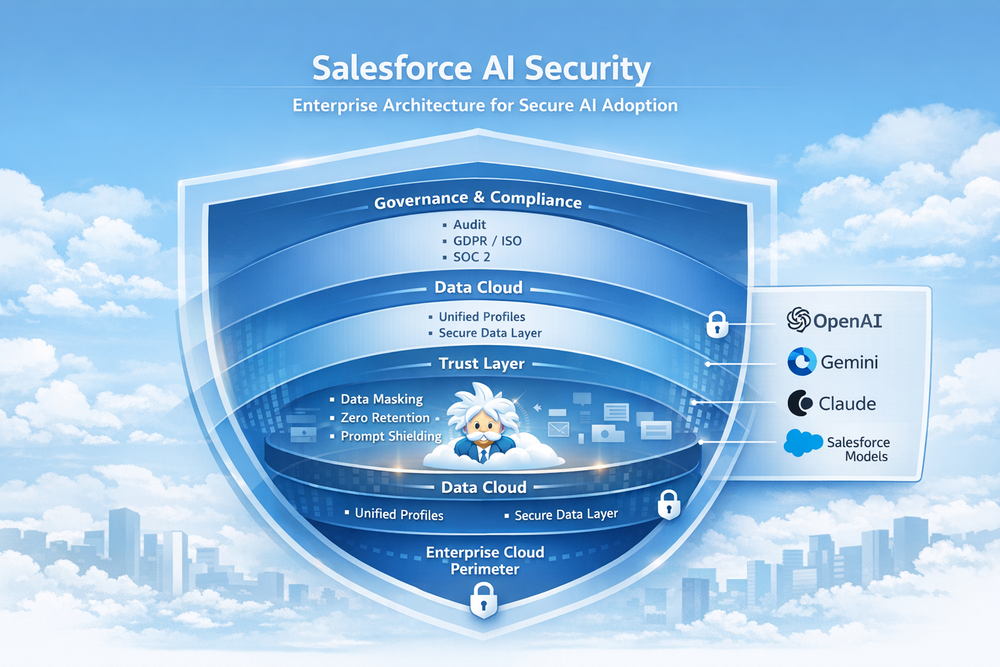
At the core of Salesforce Security is the Salesforce Trust Layer, which acts as a secure gateway between enterprise data and AI models. This layer acts as a secure gateway between enterprise data and AI models.
Instead of sending raw CRM data directly to model providers, the Trust Layer applies security controls before any information is processed. These controls include:
- data masking and redaction
- zero data retention by model providers
- grounded responses based on enterprise data
- prompt shielding against unsafe inputs
- model isolation between customers
- access control enforcement
- audit logging
The Trust Layer protects data when using:
- OpenAI
- Gemini
- Claude
- Salesforce-native models
With Salesforce Security, AI models never receive direct access to customer data. Every request is filtered, validated, and governed.
How AI Protects CRM and Customer Data
Salesforce AI is built on top of the Salesforce Platform and Data Cloud, which provide a unified and governed data foundation. Every user, role, and permission is enforced at row level and field level, and AI inherits these same controls.
Salesforce Security protects CRM and customer data through:
- unified customer profiles in Data Cloud
- row-level and field-level security
- role-based access control
- permission-based grounding
- data masking and encryption
This means AI cannot access data that a user is not authorized to see. Salesforce AI platform security ensures that AI does not bypass CRM security rules and does not introduce hidden data access paths.
AI Governance and Compliance in Salesforce
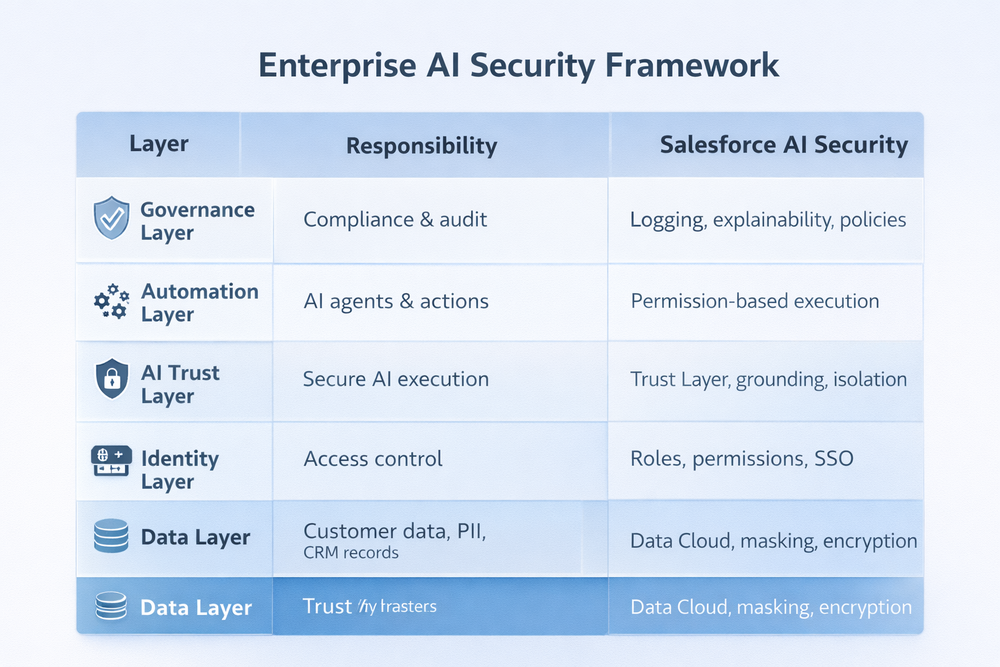
Enterprise AI must operate inside a formal governance framework. Security teams need full visibility into AI actions, compliance officers must validate regulatory alignment, and legal teams must ensure data protection obligations are met.
Salesforce Security provides built-in governance that supports audit trails, explainability, policy enforcement, and human-in-the-loop validation. Every AI-generated output and automated action can be traced back to its source, reviewed, and approved when required.
The platform follows the Salesforce security and compliance framework and is designed to support regulatory standards such as GDPR, ISO 27001, SOC 2, and HIPAA. With Salesforce Security, AI becomes part of the organization’s compliance perimeter rather than an external risk.
Security Challenges of Enterprise AI Adoption
Even the most secure platform can be undermined by poor implementation. In many enterprises, data is fragmented across systems, integrations are built without proper security review, and governance processes are still evolving.
In practice, AI security depends not only on models and data governance but also on secure Salesforce integrations with external systems such as billing, support, and communication platforms.
- inconsistent data quality
- fragmented data architecture
- unsafe API integrations
- missing approval workflows
- uncontrolled AI agents
- weak identity and access management
These issues are not caused by the platform itself, but by the absence of a security-first architecture. This is why Salesforce Security must be implemented as a platform strategy rather than simply enabled as a feature.
Best Practices for Secure AI Architecture on Salesforce
A mature AI architecture treats AI as part of the enterprise Salesforce architecture rather than a standalone system. Data must be centralized and governed, identity must be enforced consistently, integrations must follow zero-trust principles, and automation must be permission-driven.
Best practices for Salesforce AI Security include:
- AI-ready data architecture
- Data Cloud as a unified data layer
- zero-trust security model
- permission-driven automation
- secure integration patterns
- API gateway and middleware
- governance-first design
- monitoring and logging
- human-in-the-loop controls
When these principles are applied, Salesforce Security becomes a strategic enabler rather than a risk factor.
How Success Craft Helps Build Salesforce AI Security
Success Craft helps enterprises design, implement, and scale Salesforce Security across complex Salesforce environments.
The team supports customers with AI security architecture design, Salesforce Trust Layer implementation, Data Cloud preparation, secure integration patterns, AI governance models, AI agent security, and enterprise rollout. As a Salesforce Partner and enterprise integrator, Success Craft ensures that AI deployments meet the highest standards of security, compliance, and reliability.
Many enterprises also extend their AI capabilities through enterprise Salesforce applications built on AppExchange.
With a security-first approach, Success Craft enables enterprises to move from AI experimentation to production-grade AI platforms built on Salesforce Security.
When Enterprises Are Ready for Salesforce AI Adoption
An organization is ready for AI when its data foundation is mature, governance processes are in place, and security architecture is aligned with enterprise standards.
Key readiness indicators include:
- centralized and governed data
- defined AI governance model
- strong identity and access management
- secure integration landscape
- automation strategy
- compliance framework
Salesforce Security provides the framework that allows enterprises to safely scale AI across sales, service, marketing, and operations.
Conclusion
Salesforce AI is not a consumer AI tool. It is an enterprise AI platform built on security by design. Salesforce Security provides data protection, governance, compliance, and controlled automation across the entire Salesforce ecosystem.
Key takeaways:
- Salesforce AI is enterprise-grade
- Salesforce Security is built in by default
- security depends on architecture
- a trusted partner accelerates adoption
With the right architecture and the right partner, AI becomes a competitive advantage rather than a security risk.
What is Salesforce Security?
Salesforce Security is an enterprise security framework that protects CRM data, AI models, and automation using Trust Layer, Data Cloud, and built-in governance.
How does Salesforce Security protect data?
Salesforce Security uses permission-based grounding, data masking, zero data retention, and audit logging to prevent data exposure.
Is Salesforce Security compliant with GDPR?
Yes. Salesforce Security supports GDPR, ISO 27001, SOC 2, and HIPAA through built-in governance and compliance controls.
What is Salesforce Trust Layer in Salesforce Security?
The Trust Layer is the security gateway that isolates AI models from enterprise data and enforces security policies.
Can AI access all CRM data with Salesforce Security?
No. Salesforce AI Security ensures AI only sees data the user is authorized to access.
How do enterprises govern AI with Salesforce Security?
Enterprises govern AI through audit trails, explainability, policy enforcement, and human-in-the-loop validation provided by Salesforce AI Security.