

What Is Agentforce in Salesforce and How It Works
Agentforce Salesforce is transforming how automation works inside the Salesforce ecosystem. Instead of relying only on predefined rules and workflows, organizations can now use AI agents that make decisions, execute actions, and adapt to changing data in real time.
Salesforce has been evolving from a CRM platform into an intelligent system powered by AI. Agentforce represents the next step in this evolution — introducing AI-driven automation that goes beyond traditional tools like Flow and Apex.
Understanding how Agentforce Salesforce works is essential for companies that want to scale automation, improve efficiency, and build more adaptive business processes.
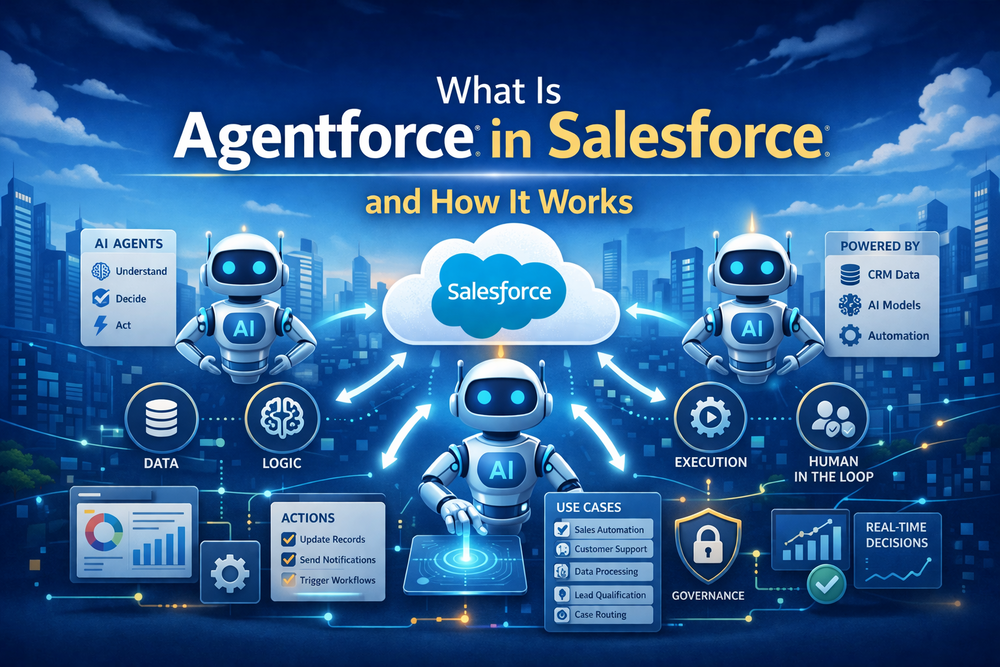
What Is Agentforce Salesforce
Agentforce Salesforce refers to AI-powered agents that operate within Salesforce environments to automate tasks, support decision-making, and enhance workflows.
Unlike traditional automation, which follows static rules, Agentforce uses:
- real-time data
- contextual understanding
- AI-driven decision logic
These agents can analyze data, trigger actions, and interact with users or systems without requiring manual intervention for every step.
How Agentforce Salesforce Works
Agentforce operates across multiple layers within Salesforce architecture.
Data Layer
AI agents rely on data from:
- Salesforce CRM objects
- external systems
- integrations and APIs
Data quality and consistency are critical for accurate agent behavior.
Logic Layer
This layer defines how agents think and act.
It includes:
- prompts
- rules
- AI models
- business logic
Unlike traditional automation, this layer can adapt based on context and data changes.
Execution Layer
This is where actions happen.
Agentforce can:
- update records
- trigger workflows
- send notifications
- interact with external systems
Human-in-the-Loop
Even with AI automation, human control remains essential.
Organizations often implement:
- approval flows
- monitoring systems
- manual overrides
This ensures that AI decisions remain aligned with business goals and compliance requirements.
Agentforce vs Traditional Salesforce Automation
Traditional Salesforce automation tools like Flow and Apex are rule-based.
Agentforce introduces a more adaptive model.
| Traditional Automation | Agentforce |
|---|---|
| rule-based logic | AI-driven decisions |
| static workflows | dynamic workflows |
| predefined outcomes | context-aware actions |
| predictable behavior | adaptive behavior |
This shift allows organizations to automate more complex processes that were previously difficult to manage.
Key Use Cases of Agentforce Salesforce
Agentforce can be applied across multiple business functions.
Sales Automation
- lead qualification
- opportunity updates
- forecasting support
Customer Support
- case routing
- automated responses
- priority detection
Data Processing
- data enrichment
- anomaly detection
- record classification
Workflow Optimization
- task automation
- decision support
- process acceleration
Challenges of Implementing Agentforce Salesforce
While powerful, Agentforce introduces new challenges.
Architecture Complexity
AI agents require structured system design and integration planning.
Data Quality Issues
AI decisions depend heavily on clean, consistent data.
Governance and Control
Without proper governance, AI behavior can become unpredictable.
Integration Complexity
Agentforce often relies on external systems and APIs, which increases system complexity.
AI Governance and Control in Agentforce
To safely implement Agentforce Salesforce, organizations must focus on governance.
Key elements include:
- human-in-the-loop controls
- permission management
- audit and monitoring
- validation processes
Salesforce provides guidance on building secure and scalable architectures
Governance ensures that AI agents operate within defined boundaries and remain aligned with business rules.
Agentforce Salesforce Architecture Best Practices
To successfully implement Agentforce, organizations should follow key architectural principles.
- design modular systems
- ensure data consistency
- build integration-ready architecture
- define fallback logic
- validate outputs before execution
A strong architecture reduces risk and improves scalability.
Learn more about Salesforce architecture and implementation
Integrating Agentforce with Salesforce Systems
Agentforce works best when integrated with the broader Salesforce ecosystem.
This includes:
- APIs
- external platforms
- data pipelines
- third-party systems
Well-designed integrations ensure that AI agents have access to the right data and can execute actions across systems.
How Success Craft Helps Implement Agentforce Salesforce
At Success Craft, implementing Agentforce Salesforce is approached as a combination of architecture, automation, and governance.
Success Craft helps organizations:
- design AI-ready Salesforce architectures
- implement Agentforce strategies
- integrate AI agents with business systems
- establish governance frameworks
- scale automation across environments
Contact the team to discuss your use case
Final Thoughts
Agentforce Salesforce represents a major shift in how automation works within Salesforce. Instead of relying only on predefined workflows, organizations can now build intelligent systems that adapt, learn, and execute decisions.
However, successful implementation requires more than just enabling AI. It requires strong architecture, governance, and integration strategy.
Companies that invest in structured implementation will be able to unlock the full potential of AI agents while maintaining control, security, and scalability.
What is Agentforce in Salesforce?
Agentforce Salesforce is a system of AI-powered agents that automate tasks, support decision-making, and enhance workflows using real-time data and context.
How does Agentforce Salesforce work?
It uses data, AI models, and automation logic to execute actions, update records, and assist users in Salesforce processes.
What is the difference between Agentforce and Flow?
Flow is rule-based automation, while Agentforce uses AI to make adaptive, context-based decisions.
Is Agentforce Salesforce suitable for enterprise use?
Yes, when implemented with proper architecture, governance, and monitoring, it can support scalable enterprise automation.
Can Agentforce be integrated with external systems?
Yes. Agentforce can connect with APIs and external platforms to enable data-driven automation across systems.