

Agentforce vs Salesforce Flow: Key Differences and Use Cases
Agentforce vs Salesforce Flow is one of the most important questions for organizations building automation in Salesforce today. As Salesforce evolves, companies are no longer limited to rule-based workflows — they can now leverage AI-powered agents to automate more complex processes.
Traditional automation tools like Salesforce Flow remain essential, but Agentforce introduces a new layer of intelligence that enables dynamic decision-making. Understanding the difference between Agentforce vs Salesforce Flow helps organizations choose the right approach for scalable and efficient automation.
What Is Salesforce Flow
Salesforce Flow is a declarative automation tool used to build workflows based on predefined rules and logic.
Flow allows teams to:
- automate record updates
- create approval processes
- trigger actions based on events
- build guided user interactions
It is widely used because it is:
- predictable
- easy to maintain
- well-suited for structured processes
Salesforce Flow works best when the logic is clearly defined and does not change frequently.
What Is Agentforce Salesforce
Agentforce Salesforce introduces AI-powered agents that can analyze data, make decisions, and execute actions dynamically.
Unlike Flow, Agentforce is not limited to predefined rules. It can:
- interpret context
- adapt to changing data
- make intelligent decisions
- automate complex workflows
If you want a deeper explanation, see:
https://success-craft.com/blog/what-is-agentforce-salesforce/
Agentforce vs Salesforce Flow: Core Differences
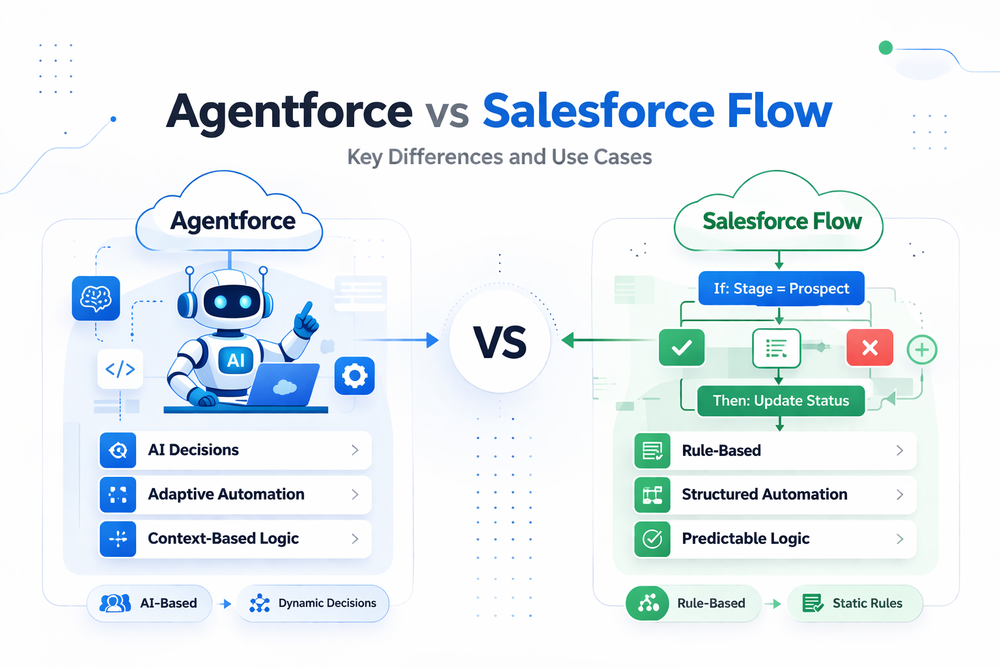
Understanding Agentforce vs Salesforce Flow requires comparing how each approach works.
| Feature | Salesforce Flow | Agentforce |
|---|---|---|
| Logic | rule-based | AI-driven |
| Behavior | static | adaptive |
| Complexity | low to medium | medium to high |
| Use cases | structured workflows | dynamic processes |
| Decision-making | predefined | context-based |
Salesforce Flow executes predefined logic, while Agentforce can adjust its behavior based on data and context.
When to Use Salesforce Flow
Salesforce Flow is the best choice for predictable and structured automation.
Use Flow when:
- processes follow clear rules
- outcomes are consistent
- logic does not require interpretation
- compliance requires strict control
Typical use cases include:
- approval processes
- record updates
- notifications
- simple routing logic
Flow provides stability and transparency, which is critical for many business processes.
When to Use Agentforce
Agentforce is designed for more complex and dynamic scenarios.
Use Agentforce when:
- decisions depend on context
- inputs vary significantly
- processes cannot be fully predefined
- AI can improve efficiency
Typical use cases include:
- lead scoring and qualification
- case prioritization
- intelligent routing
- data classification
Agentforce enables automation in areas where traditional tools struggle.
Combining Agentforce and Salesforce Flow
The most effective approach is often not choosing between Agentforce vs Salesforce Flow, but combining them.
Example architecture:
Flow → triggers process
Agentforce → makes decision
Flow → executes structured actions
This hybrid model allows organizations to:
- maintain control
- introduce AI gradually
- balance flexibility and reliability
Challenges of Agentforce vs Salesforce Flow
While both tools are powerful, they come with different challenges.
Salesforce Flow Challenges
- limited flexibility
- difficult to scale complex logic
- requires updates when rules change
Agentforce Challenges
- higher architectural complexity
- dependency on data quality
- need for governance and monitoring
- less predictable behavior
Organizations must carefully evaluate these factors before choosing an approach.
Architecture Considerations for Automation
Choosing between Agentforce vs Salesforce Flow is not just a technical decision — it is an architectural one.
Key considerations include:
- data quality and consistency
- system scalability
- integration with external systems
- monitoring and control
- fallback logic
A well-designed architecture ensures that automation remains reliable and scalable.
Learn more about Salesforce architecture and implementation:
https://success-craft.com/services/salesforce-consulting-services/
Integrations and Automation Ecosystem
Both Agentforce and Salesforce Flow rely on integrations.
Automation often involves:
- APIs
- external systems
- data pipelines
- third-party tools
Well-structured integrations allow automation to operate across the entire business ecosystem.
Explore integration services:
https://success-craft.com/integrations/
How Success Craft Helps Choose the Right Approach
At Success Craft, choosing between Agentforce vs Salesforce Flow is part of a broader automation strategy.
Success Craft helps organizations:
- analyze automation needs
- design scalable architecture
- implement AI-driven workflows
- integrate systems
- establish governance and monitoring
Contact the team to discuss your use case:
https://success-craft.com/contact-us/
Final Thoughts
Agentforce vs Salesforce Flow is not about replacing one tool with another. Each serves a different purpose.
Salesforce Flow remains the foundation for structured automation, while Agentforce expands what is possible with AI-driven decision-making.
Organizations that combine both approaches can build automation systems that are both reliable and intelligent, enabling scalable growth and improved efficiency.
What is the difference between Agentforce and Salesforce Flow?
Agentforce uses AI for dynamic decision-making, while Salesforce Flow is based on predefined rules and structured automation.
When should I use Salesforce Flow?
Salesforce Flow is best for predictable processes with clearly defined logic, such as approvals, updates, and simple workflows.
When should I use Agentforce?
Agentforce is suitable for complex workflows where decisions depend on context, data, and AI-driven analysis.
Can Agentforce replace Salesforce Flow?
No. Agentforce and Salesforce Flow serve different purposes and are often used together.
Is Agentforce more powerful than Salesforce Flow?
Agentforce is more flexible for complex automation, while Salesforce Flow is more reliable for structured processes.