

CI/CD vs Release Operations in Salesforce: What’s the Difference
CI/CD in Salesforce is widely adopted by teams aiming to automate deployments and speed up delivery. However, many organizations discover that even with successful CI/CD pipelines, production issues still occur.
The reason is simple: CI/CD focuses on deploying metadata, but it does not guarantee that the system will work correctly in production.
This is where Salesforce release operations come in. Understanding the difference between CI/CD and release operations in Salesforce is critical for building reliable and scalable release processes.
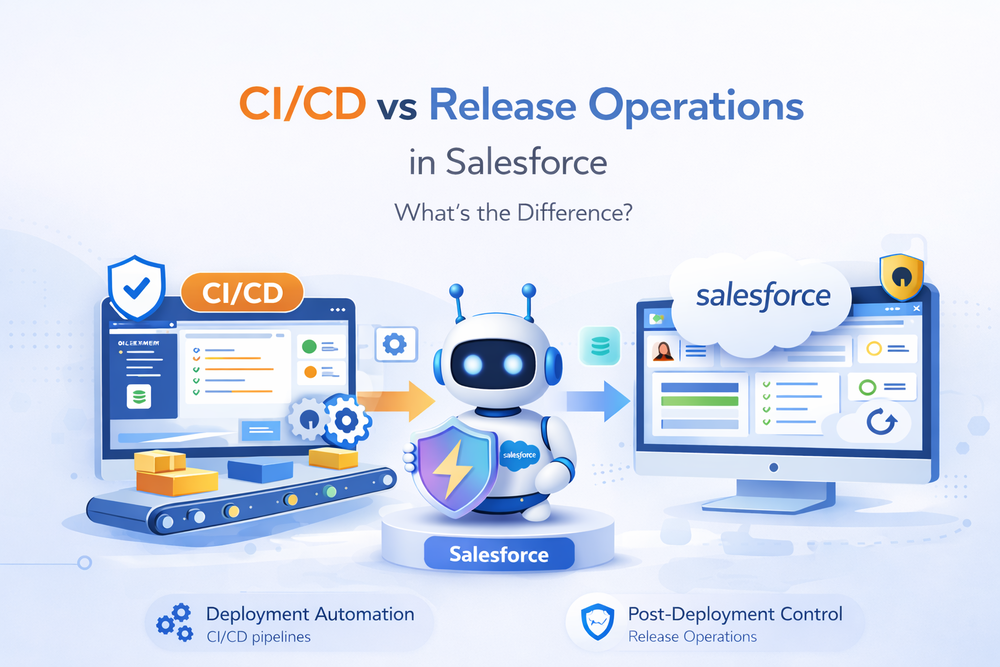
What Is CI/CD in Salesforce
CI/CD (Continuous Integration and Continuous Delivery) in Salesforce is a set of practices that automate the deployment of changes across environments.
It typically includes:
- version control (Git)
- automated testing
- deployment pipelines
- validation before release
CI/CD tools such as Gearset or Copado help teams move metadata between environments faster and with fewer errors.
Learn more about Salesforce development and APIs
What Are Salesforce Release Operations
Salesforce release operations refer to all activities that happen after deployment to ensure that the system is fully functional in production.
This includes:
- configuration updates
- data validation
- permission adjustments
- UI and layout checks
- integration verification
Unlike CI/CD, release operations focus on how the system behaves in real-world usage.
CI/CD vs Salesforce Release Operations: Key Differences
The difference between CI/CD and Salesforce release operations is often misunderstood.
- CI/CD is responsible for delivering changes
- Release operations ensure those changes actually work
CI/CD answers:
“Was the deployment successful?”
Release operations answer:
“Is the system working correctly in production?”
Both are essential, but they solve different problems.
What Happens After Salesforce Deployment
After a deployment is completed, several critical steps must take place.
These include:
- validating data consistency
- checking user permissions
- verifying page layouts
- testing automation (Flows, Apex, triggers)
- ensuring integrations are working
Even when deployment succeeds, issues can appear due to runtime dependencies.
Why CI/CD Is Not Enough in Salesforce
Salesforce is a stateful platform, meaning that system behavior depends not only on metadata but also on:
- existing data
- automation logic
- integrations
- user permissions
Because of this, a “green deployment” does not guarantee a working system.
CI/CD tools do not fully account for:
- data-related issues
- asynchronous processes
- real-time integrations
- cross-object dependencies
That is why Salesforce release operations are required.
Common Post-Deployment Problems in Salesforce
Organizations frequently encounter issues after deployment.
Broken Automation
Flows or triggers behave differently in production due to data variations.
Permission Issues
Users cannot access new features or data.
Integration Failures
External systems fail to sync correctly.
Configuration Drift
Different environments become inconsistent over time.
Incomplete Setup
Manual steps are missed during release execution.
What Salesforce Release Operations Look Like in Practice
In many teams, release operations are still handled manually.
Typical activities include:
- running checklists
- executing scripts
- updating configurations
- coordinating across teams
This approach is slow, error-prone, and difficult to scale.
How to Automate Salesforce Release Operations
To improve reliability, organizations are moving toward automation.
Key automation areas include:
- post-deployment validation
- configuration synchronization
- bulk updates across environments
- rollback and recovery processes
Automation reduces human error and improves release consistency.
How ZuppIO Solves Release Operations Challenges
This is where ZuppIO comes into play.
ZuppIO is designed specifically for Salesforce release operations — the layer that exists between deployment and a fully working system.
With ZuppIO, teams can:
- automate post-deployment tasks
- perform bulk operations across multiple orgs
- validate releases in real time
- execute rollback strategies when needed
- synchronize configurations between environments
Integration and Architecture Considerations
Release operations should be part of a broader architecture strategy.
Organizations need to consider:
- multi-org environments
- integration dependencies
- data ownership
- system consistency
Learn more about integration strategies
Role of Success Craft in Salesforce Release Management
At Success Craft, release management is approached as a combination of DevOps, architecture, and operational control.
Success Craft helps organizations:
- design scalable release strategies
- implement CI/CD pipelines
- optimize post-deployment processes
- integrate tools like ZuppIO
- manage complex multi-org environments
Final Thoughts
CI/CD is an essential part of modern Salesforce development, but it is only one part of the release lifecycle.
Salesforce release operations ensure that deployments translate into working, reliable systems in production.
Organizations that focus only on CI/CD risk missing critical operational steps. Those that combine CI/CD with release operations gain:
- better system stability
- fewer production issues
- faster recovery from errors
- improved scalability
The future of Salesforce DevOps is not just deployment automation — it is full release operations automation.
What is CI/CD in Salesforce?
CI/CD in Salesforce automates the deployment and testing of metadata changes across environments.
What are Salesforce release operations?
Salesforce release operations include post-deployment activities required to ensure the system works correctly in production.
Why is CI/CD not enough in Salesforce?
Because deployment does not guarantee correct runtime behavior, especially in a stateful platform like Salesforce.
What happens after deployment in Salesforce?
Teams must validate data, update configurations, check permissions, and ensure integrations are functioning correctly.
Can Salesforce release operations be automated?
Yes. Platforms like ZuppIO allow teams to automate validation, configuration updates, and multi-org coordination.