

Human-in-the-Loop AI Automation in Salesforce: Enterprise Control at Scale
Human-in-the-Loop AI Automation in Salesforce is an enterprise approach that combines artificial intelligence with structured human oversight to ensure security, compliance, and operational reliability. This model helps organizations working with Salesforce consulting partners automate complex workflows while maintaining full control over critical business decisions. By embedding human review into AI-driven processes, enterprises can scale automation without exposing themselves to legal, financial, or reputational risks.
Why Fully Autonomous AI Fails in Enterprise Environments
Many organizations initially see autonomous AI as the ultimate stage of digital transformation. Systems that operate without human involvement promise cost reduction and faster execution. In practice, however, this approach rarely works in complex enterprise environments.
Salesforce platforms manage customer identities, financial transactions, contractual obligations, and regulatory records. When AI systems operate independently, even minor inaccuracies can propagate across multiple workflows. A misclassified opportunity, incorrect customer context, or incomplete compliance rule can quickly result in revenue loss or regulatory exposure.
Most failed automation initiatives share common structural weaknesses:
- unclear ownership of AI-driven decisions
- inconsistent approval mechanisms
- fragmented or poorly governed data
- undocumented risk policies
- limited monitoring capabilities
Without these foundations, fully autonomous AI weakens accountability and increases operational risk.
What Human-in-the-Loop AI Automation Means in Salesforce
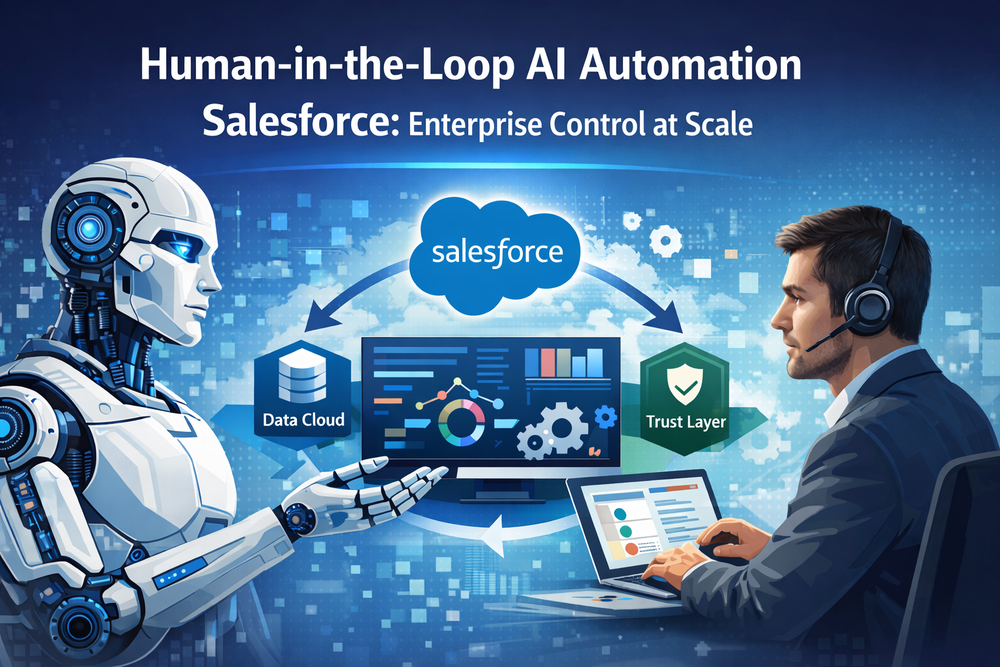
Within the Salesforce ecosystem, Human-in-the-Loop AI Automation represents a governance-driven collaboration between intelligent systems and domain experts. AI is responsible for large-scale data analysis and pattern recognition, while humans apply business context, regulatory awareness, and strategic judgment.
A mature Human-in-the-Loop model typically includes automated validation rules, structured approval workflows, escalation mechanisms, execution control layers, and centralized audit logging. Together, these elements ensure that automation remains fast, consistent, and aligned with enterprise policies.
Rather than replacing employees, this approach elevates their role. AI becomes a decision-support system operating within clearly defined boundaries.
How Salesforce Implements Human-in-the-Loop Architecture
Salesforce provides a comprehensive platform architecture that supports Human-in-the-Loop AI Automation across data, security, and process layers.
At the foundation lies Salesforce Data Cloud, which provides a unified and governed data layer for AI-driven workflows. On top of this foundation, Einstein and AI Cloud generate predictions and recommendations. The Salesforce Trust Layer enforces data masking, access control, and grounding policies.
Workflow governance is implemented through Flow, Approval Processes, and permission frameworks. This approach depends heavily on secure Salesforce integrations with ERP, billing, and support platforms.
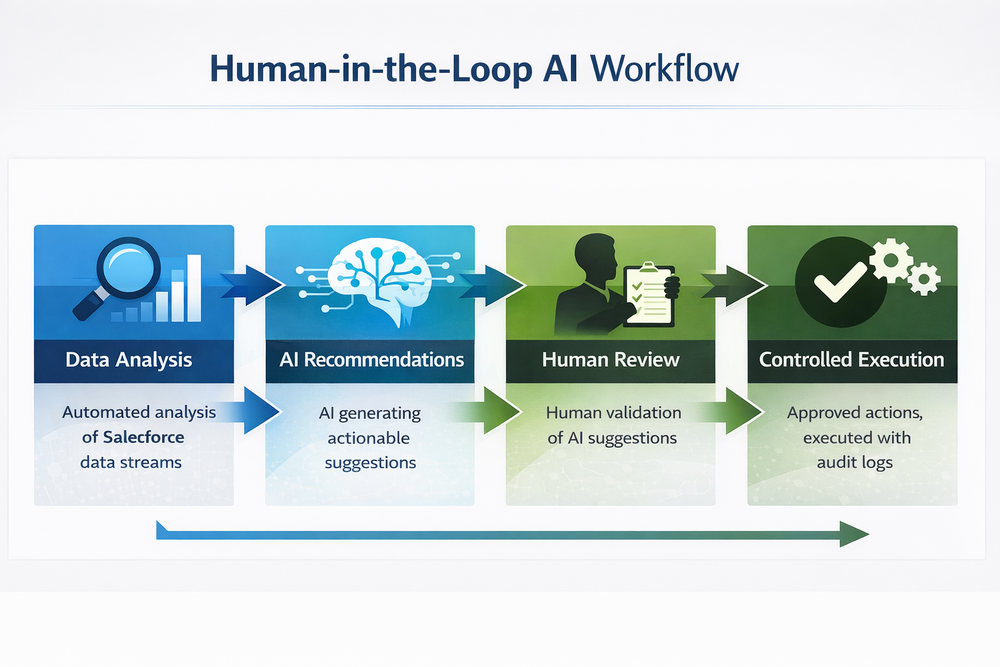
A typical Human-in-the-Loop workflow includes:
- Contextual data analysis
- AI recommendation generation
- Policy-based validation
- Human review and approval
- Controlled execution
- Centralized audit logging
Governance, Risk, and Compliance in Human-in-the-Loop Systems
Governance is a primary driver of Human-in-the-Loop adoption in enterprise environments. Regulators, auditors, and internal risk teams require organizations to demonstrate how automated decisions are generated, reviewed, and authorized.
Human-in-the-Loop systems enable traceable approval chains, partially explainable and fully traceable outputs, policy-based enforcement, documented accountability, and regulatory reporting. Governance-ready organizations maintain formal AI policies, approval matrices, compliance mappings, review procedures, and incident response plans.
These controls align with Salesforce’s broader security and compliance framework and support requirements related to GDPR, SOC 2, ISO 27001, and HIPAA. Human oversight strengthens legal defensibility and reduces systemic risk.
Enterprise Use Cases for Human-in-the-Loop Automation
Human-in-the-Loop AI Automation delivers measurable value across business domains where decisions have financial, legal, or reputational impact.
Sales and Revenue Operations
AI analyzes pipeline performance, pricing history, and customer behavior to generate recommendations. Sales leaders validate discount strategies, contract structures, and prioritization models before execution.
Customer Service and Support
AI assists with case classification, response generation, and escalation planning. Agents review sensitive communications and high-impact actions to ensure service quality and compliance.
Finance and Compliance
Finance teams use controlled automation to detect anomalies, validate invoices, and monitor transactions. Human reviewers confirm exceptions and approve high-risk payments.
Operations and Administration
Operational workflows such as access management, account provisioning, and data remediation benefit from strong governance and auditability.
Organizations typically adopt this model to achieve:
- reduced operational risk
- higher process reliability
- improved regulatory posture
- faster decision cycles
- increased stakeholder trust
Common Mistakes When Implementing Human-in-the-Loop AI
Despite its advantages, Human-in-the-Loop AI Automation is frequently undermined by organizational and architectural weaknesses.
Common failure patterns include:
- excessive approval layers that slow execution
- insufficient controls for high-risk actions
- fragmented data and integration landscapes
- poorly designed reviewer interfaces
- unclear accountability models
These issues are rarely caused by platform limitations. They reflect insufficient cross-functional coordination and limited executive sponsorship.
Best Practices for Scalable Human-in-the-Loop Design
Scalable Human-in-the-Loop systems balance automation efficiency with governance rigor. High-performing organizations classify processes by risk level, apply tiered approval structures, and implement dynamic routing mechanisms.
Additional best practices include continuous feedback loops, centralized governance boards, integrated monitoring, regular model retraining, and lifecycle management. Strong reviewer experience design is critical for long-term adoption.
When applied consistently, these practices transform Human-in-the-Loop into a sustainable enterprise capability.
How Success Craft Builds Human-in-the-Loop AI Systems
Success Craft supports enterprises throughout the lifecycle of Human-in-the-Loop AI initiatives.
Most projects begin with enterprise Salesforce consulting services that assess data readiness, governance maturity, and integration architecture.
Secure workflows rely on secure Salesforce integrations with external systems.
Complex automation is implemented within enterprise Salesforce architecture using hybrid applications.
For ISVs, Human-in-the-Loop capabilities are embedded into enterprise Salesforce applications built for AppExchange.
The delivery framework covers:
- readiness assessment
- security-first architecture
- governance setup
- technical implementation
- continuous optimization
This approach ensures sustainable adoption and long-term value.
When Enterprises Are Ready for Human-in-the-Loop AI
Organizations are prepared for advanced AI automation when foundational capabilities are in place.
Enterprises are usually ready when they have:
- governed and high-quality data
- formal security policies
- mature integration landscape
- executive sponsorship
- clearly defined operational ownership
Under these conditions, Human-in-the-Loop AI Automation becomes a strategic enabler rather than a risk factor.
Conclusion
Human-in-the-Loop AI Automation represents a cornerstone of responsible enterprise AI adoption. By combining intelligent automation with structured human judgment, organizations can scale innovation while maintaining trust, transparency, and compliance.
Within Salesforce environments, this approach enables enterprises to deploy AI confidently across sales, service, finance, and operations. With the right architecture, governance model, and implementation partner, automation becomes a long-term competitive advantage.
Success Craft helps organizations design, implement, and optimize Human-in-the-Loop AI Automation systems that deliver sustainable business value.
What is Human-in-the-Loop AI Automation?
It is an approach where AI systems operate under structured human supervision to ensure reliable and compliant decision-making.
Why is Human-in-the-Loop important in Salesforce?
It helps organizations maintain governance, security, and accountability in AI-driven workflows.
Does Human-in-the-Loop slow down automation?
When designed correctly, it improves reliability without significantly reducing operational speed.
How does Salesforce support approval workflows for AI?
Salesforce uses Flow, native Approval Processes, Trust Layer, and governance features to embed human validation.
Is Human-in-the-Loop required for compliance?
In regulated industries, human oversight is essential for meeting audit and transparency requirements.
How can Success Craft help implement Human-in-the-Loop systems?
Success Craft designs secure architectures, builds governance frameworks, and supports enterprise-scale deployment.