

Node.js vs Python for Backend Development
Choosing a backend technology is not simply a question of which language is faster or more popular. This Node.js vs Python for backend development comparison examines how the decision affects application architecture, hiring, delivery speed, infrastructure costs, integrations, and the product’s ability to evolve over time.
Node.js and Python are both established options for backend development, but they solve different problems particularly well. Node.js is built around JavaScript, an event loop, and non-blocking I/O. Python emphasizes readable syntax, a broad software ecosystem, and strong frameworks for web development, automation, data engineering, and artificial intelligence.
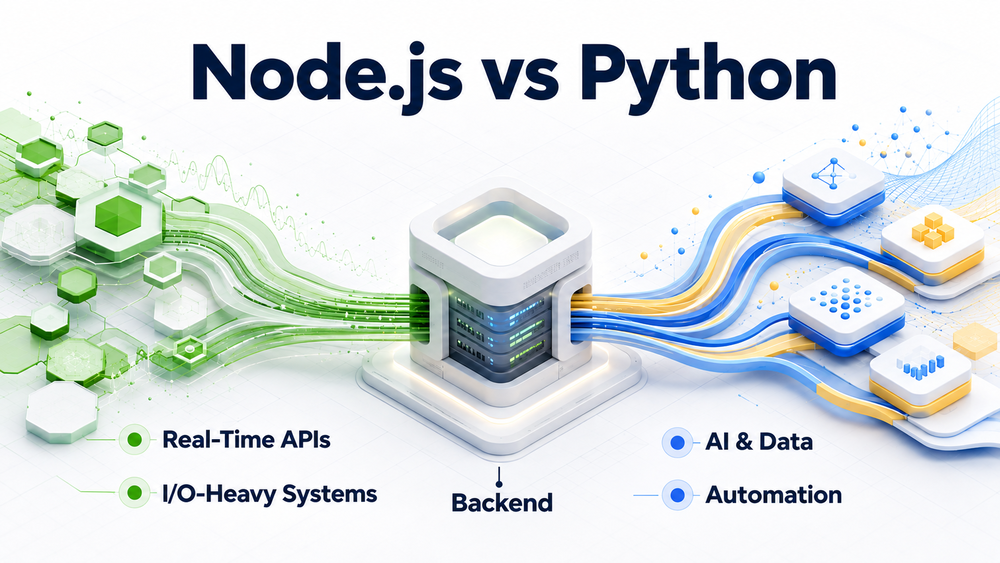
The practical answer is not that one technology is universally better. Node.js is often the stronger fit for I/O-heavy APIs, real-time systems, and JavaScript-centered product teams. Python is frequently the better choice when the backend depends on data processing, machine learning, scientific libraries, automation, or rapid development with mature web frameworks.
This comparison explains where those differences matter and how to choose between Node.js and Python for a real backend project.
What Is Node.js?
Node.js is an open-source, cross-platform JavaScript runtime. It executes JavaScript outside the browser and provides server-side APIs for HTTP, networking, file systems, streams, processes, and other operating-system capabilities.
Its defining characteristic is an asynchronous, event-driven architecture. After executing an application script, Node.js enters an event loop and processes callbacks as work becomes ready.
HTTP and streaming are first-class parts of the runtime, which makes Node.js well suited to applications that spend much of their time waiting for network, database, file, or external API operations.
Node.js is commonly paired with frameworks such as Express, Fastify, or NestJS and with TypeScript for stronger type safety in larger applications.
What Is Python?
Python is a general-purpose programming language known for readable syntax and a large ecosystem.
For backend development, teams commonly use Django, FastAPI, or Flask.
Django provides a comprehensive web framework with features such as an ORM, authentication, administration, forms, and security protections. FastAPI focuses on modern API development, type hints, and asynchronous request handling, while Flask offers a smaller foundation that teams can extend selectively.
Python also has a major advantage outside traditional web development: the same ecosystem is widely used for machine learning, data analysis, automation, scientific computing, and scripting.
That can reduce friction when a backend needs to serve models, orchestrate data workflows, or share logic with analytics and AI teams.
Node.js vs Python for Backend Development: Quick Comparison
| Decision factor | Node.js | Python |
|---|---|---|
| Core strength | Concurrent I/O and real-time communication | Developer productivity, data, automation, and AI |
| Typical backend style | Event-driven and non-blocking by default | Synchronous or asynchronous, depending on the framework |
| Strong use cases | APIs, WebSockets, SaaS, integrations, BFF services | Django applications, AI services, data platforms, automation |
| CPU-heavy work | Usually requires workers, processes, or separate services | Often uses processes or optimized native libraries |
| Full-stack alignment | JavaScript or TypeScript across frontend and backend | A separate frontend language is usually required |
| Framework approach | Often modular and composable | Ranges from minimal Flask to batteries-included Django |
1. Performance and Concurrency
Performance comparisons are meaningful only when they reflect the actual workload. A synthetic request-per-second benchmark cannot fully explain how a system will behave when database queries, authentication, business rules, external APIs, caching, and infrastructure are included.
Node.js for I/O-Bound Workloads
Node.js is designed for scalable network applications. Its event loop allows one process to coordinate many ongoing I/O operations without assigning a dedicated application thread to every connection.
This is valuable for:
- APIs;
- webhooks;
- streaming;
- chat applications;
- notification systems;
- services communicating with multiple external platforms.
The trade-off is that expensive synchronous computation can block the event loop and delay unrelated requests.
Worker Threads, child processes, queues, or separate compute services can isolate CPU-intensive work, but the architecture must account for that explicitly.
Python for Flexible Concurrency and Compute Ecosystems
Python supports asynchronous I/O through asyncio, which provides an event loop for network I/O, subprocesses, and concurrent tasks. Modern frameworks can use async and await for high-concurrency services.
Python also supports process-based parallelism through multiprocessing and ProcessPoolExecutor, allowing CPU-bound tasks to use multiple processors.
For numerical and machine-learning workloads, much of the heavy computation may run in optimized native libraries rather than pure Python.
Python can also handle CPU-intensive workloads through multiprocessing, separate workers, or optimized native libraries. However, ordinary Python code does not automatically outperform Node.js for CPU-bound computation.
This is why a simplistic language-level speed comparison can be misleading. The framework, database access pattern, serialization, model runtime, deployment topology, and native dependencies can matter more than the syntax used to connect them.
Node.js has a natural advantage for highly concurrent I/O and real-time communication. Python is highly capable for APIs too, but becomes especially attractive when compute, data, or AI libraries are central to the backend.
2. Development Speed and Maintainability
Python is often praised for concise, readable code. Django can accelerate the development of database-driven business applications because authentication, permissions, forms, migrations, an ORM, and an administration interface are available within one integrated framework.
Node.js can also support fast delivery, especially when a team already uses JavaScript or TypeScript.
Sharing language knowledge, types, validation models, tooling, and package conventions across frontend and backend teams can reduce context switching.
Framework choice matters as well. Express offers flexibility with limited predefined structure, while NestJS provides a more opinionated architecture for larger applications.
Maintainability depends less on language reputation than on engineering discipline. Clear module boundaries, automated tests, dependency governance, observability, code review, and architectural consistency are necessary in both ecosystems.
3. Frameworks and Ecosystem
Node.js Ecosystem
Common Node.js frameworks include:
- Express for minimal, flexible HTTP services and APIs;
- Fastify for performance-oriented APIs with a plugin architecture;
- NestJS for structured TypeScript applications with modules and dependency injection.
Node.js also provides access to the large npm ecosystem, which includes packages for web development, authentication, integrations, messaging, databases, and cloud platforms.
The modular ecosystem gives teams significant freedom. However, that freedom can produce inconsistent architecture or dependency sprawl if standards are not defined early.
Python Ecosystem
Common Python backend frameworks include:
- Django for full-featured business applications and content or data-driven platforms;
- FastAPI for typed, modern API services and asynchronous endpoints;
- Flask for smaller services and applications that need a minimal foundation.
Python also has extensive libraries for AI, machine learning, data engineering, automation, and scientific computing.
Its ecosystem can be decisive when the backend is part of a broader data or AI system. The web layer and the analytical layer can often remain within the same language ecosystem, even if they are deployed as separate services.
4. Scalability
Both Node.js and Python can scale successfully. Neither language removes the need for good system design.
Node.js applications typically scale through multiple processes, containers, horizontal replicas, queues, and load balancers.
Its non-blocking model is effective when each instance coordinates many network operations, but CPU-heavy work should not remain on the main event loop.
Python applications also scale horizontally with multiple application workers and containers. Asynchronous frameworks can handle concurrent I/O, while task queues and worker processes can isolate background or compute-intensive jobs.
Large Django and Python systems commonly use caching, database replication, asynchronous jobs, and service decomposition, just as systems built with other languages do.
The more useful question is: what will limit this specific system first?
In many applications, the answer is the database, inefficient queries, external services, poor caching, or architecture—not the programming language.
5. Real-Time Applications
Node.js is a strong default for chat applications, collaboration tools, live dashboards, multiplayer services, notification systems, and other products that maintain many active connections.
Its event-driven model aligns naturally with WebSockets and frequent small messages.
Python can also support real-time communication through asynchronous frameworks and servers.
However, if real-time interaction is the central workload and the team is already comfortable with TypeScript, Node.js often provides the more direct path.
6. AI, Machine Learning, and Data-Intensive Backends
Python is usually the stronger choice when the backend must train, evaluate, orchestrate, or serve machine-learning models, or perform substantial data analysis.
Its ecosystem includes widely adopted libraries and tools for:
- numerical computing;
- data processing;
- natural language processing;
- computer vision;
- model development.
Node.js can call AI APIs, coordinate workflows, stream model responses, and serve as an effective application or integration layer.
A common hybrid architecture uses Node.js for the customer-facing API and real-time communication while a Python service owns model inference or data processing.
This division avoids forcing one runtime to handle every concern. It also allows specialized teams to use the ecosystem that best fits their workload.
7. APIs, Integrations, and Microservices
Node.js is particularly effective as an API gateway, backend-for-frontend layer, webhook processor, or integration service.
Our Node.js REST API development guide explains the architecture, validation, security, testing, and performance considerations in more detail.
JavaScript provides built-in JSON parsing and serialization, asynchronous API calls are central to the runtime, and teams can use the same language across browser clients and server endpoints.
Python is equally practical for REST APIs and microservices, especially with FastAPI or Django REST Framework. It may be preferable when the service includes complex business rules, document processing, automation, analytics, or model inference.
For integration-heavy enterprise systems, the decision should also account for:
- SDK availability;
- authentication requirements;
- API rate limits;
- message queues;
- failure recovery;
- observability;
- existing team experience.
These factors are often more important than HTTP throughput alone.
8. Security
Neither Node.js nor Python is automatically secure simply because of the language.
Security depends on framework configuration, dependency management, authentication, authorization, secret handling, validation, logging, patching, and deployment practices.
Node.js teams should pay particular attention to npm dependency governance, event-loop denial-of-service risks, unsafe parsing, and accidental exposure of asynchronous errors.
Python teams should carefully manage package provenance, framework settings, serialization risks, and production server configuration.
Mature frameworks in both ecosystems provide security features, but teams still need threat modeling, automated dependency scanning, secure code review, and timely updates.
9. Hiring and Team Structure
Node.js can simplify staffing for JavaScript-centered organizations because frontend developers already understand the language.
That does not make backend engineering interchangeable with frontend work, but it can improve collaboration and make shared tooling more practical.
Python has a large developer community spanning backend development, DevOps, data engineering, analytics, and AI.
It is particularly useful when product engineers need to collaborate closely with data scientists or machine-learning engineers.
The best technology is frequently the one a capable team can operate reliably. A theoretical performance advantage rarely compensates for weak expertise, inconsistent architecture, or slow incident response.
When Should You Choose Node.js?
Choose Node.js when most of the following are true:
- the application is dominated by API, network, database, or external-service I/O;
- real-time communication or many concurrent connections are central requirements;
- the frontend already uses JavaScript or TypeScript and shared language expertise provides real value;
- you are building APIs, SaaS backends, integration services, webhook processors, or backend-for-frontend layers;
- CPU-intensive work can be isolated in workers, queues, or specialized services.
When Should You Choose Python?
Choose Python when most of the following are true:
- AI, machine learning, analytics, data processing, or automation is a core part of the product;
- you need rapid development with a mature, integrated framework such as Django;
- the organization already has strong Python, data, or scientific-computing expertise;
- the backend contains substantial document processing, scripting, or workflow automation;
- a Python-specific library provides a meaningful product or delivery advantage.
When a Hybrid Architecture Makes More Sense
The Node.js vs Python decision does not always need a single winner.
A product can use Node.js for a real-time API gateway and Python for AI inference, data processing, or scheduled analysis. Services can communicate through HTTP, gRPC, events, or a message broker.
A hybrid architecture is justified when the separation follows clear business capabilities or workload boundaries. It is not justified merely to use more technologies.
Every additional runtime adds deployment, observability, security, and operational complexity.
Node.js vs Python: Final Decision Framework
| If your highest priority is… | Preferred starting point | Why |
|---|---|---|
| Real-time connections and I/O concurrency | Node.js | Its event-driven architecture aligns naturally with network-heavy workloads |
| AI, machine learning, analytics, or scientific tooling | Python | Its ecosystem provides direct access to widely used data and model libraries |
| One language across a TypeScript product team | Node.js | Shared language and tooling can reduce coordination overhead |
| Rapid delivery of a database-driven business application | Python with Django | Integrated framework capabilities reduce assembly work |
| Integration and webhook orchestration | Node.js | It is a strong fit for asynchronous API communication and JSON workflows |
| Mixed real-time and AI workloads | Hybrid architecture | Separate services can use the best runtime for each responsibility |
Conclusion
Node.js and Python are both strong backend technologies, but they optimize for different development contexts.
Node.js is a compelling choice for I/O-intensive APIs, real-time applications, SaaS platforms, and integration layers—especially when a team already works in JavaScript or TypeScript.
Python is often the better choice for AI-enabled products, data-intensive services, automation, and business applications that benefit from mature, integrated frameworks.
The final Node.js vs Python for backend development decision should be based on workload, ecosystem dependencies, team expertise, operational requirements, and the expected evolution of the product.
If those factors point in different directions, a carefully bounded hybrid architecture may be more effective than forcing the entire backend into one runtime.
Success Craft develops backend applications, APIs, integrations, and scalable digital products using technologies selected around real business and architectural requirements.
Explore what Node.js is and how it works for a closer look at the runtime’s architecture and common use cases.
Is Node.js better than Python for backend development?
Neither is universally better.
Node.js is often preferable for I/O-heavy APIs and real-time systems, while Python is frequently stronger for AI, data processing, automation, and applications built with comprehensive frameworks such as Django.
Which is faster: Node.js or Python?
Node.js often performs well for concurrent network and I/O workloads.
Python performance depends heavily on the framework, server configuration, asynchronous design, and whether computation runs in optimized native libraries.
The actual workload should be benchmarked instead of relying on a general language ranking.
Can Python handle real-time applications?
Yes. Python supports asynchronous I/O and real-time frameworks.
However, Node.js is often the more natural default when persistent connections and frequent network events are the central workload.
Is Node.js suitable for AI backends?
Node.js can call AI services, stream responses, and orchestrate application workflows.
Python is usually preferred for model development, data science, and workloads that depend directly on machine-learning libraries. Many systems use both technologies.
Should a startup choose Node.js or Python?
A startup should choose based on its product workload and team.
Node.js can be efficient for JavaScript-led SaaS and real-time products. Python can accelerate the development of AI, automation, and data-driven products.
Delivery capability and maintainability matter more than popularity.
Can Node.js and Python be used together?
Yes. A common architecture uses Node.js for client-facing APIs or real-time services and Python for AI, analytics, or background processing.
The boundary between the technologies should be operationally justified and clearly owned.