

Salesforce Connected Apps Security Changes: PKCE and Token Rotation Explained
Salesforce Connected Apps security changes are becoming increasingly important as the platform introduces stricter OAuth requirements, including PKCE and refresh token rotation.
These updates impact how integrations authenticate and maintain access. While not all integrations will break, applications that rely on outdated OAuth implementations may experience authentication issues and require updates.
Understanding these Salesforce Connected Apps security changes is critical for maintaining stable integrations and avoiding disruptions in production environments.
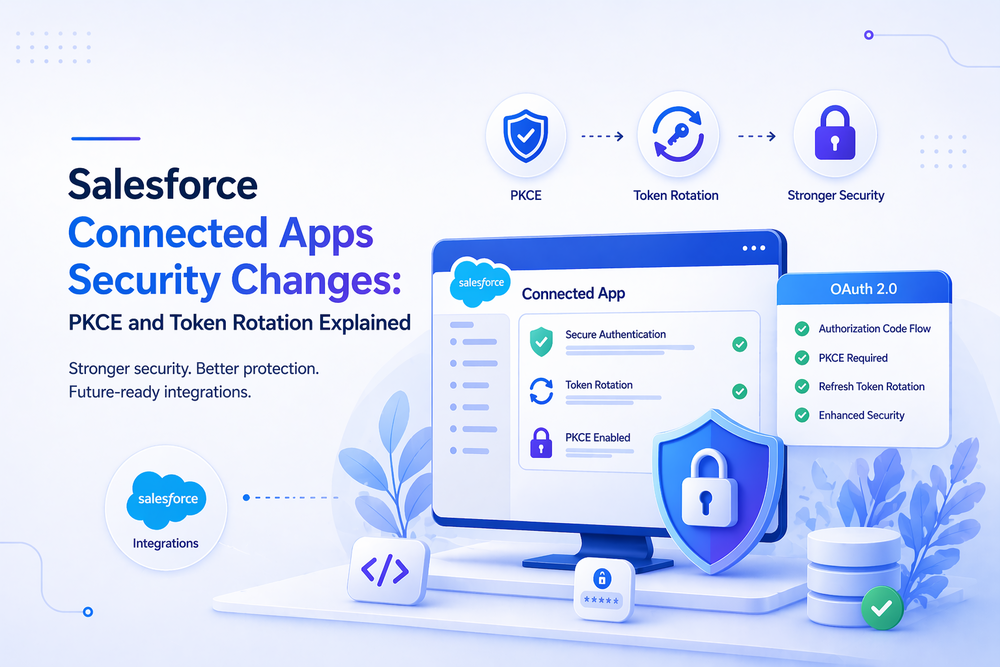
What Changed in Salesforce Connected Apps Security
Salesforce is introducing updates to Connected Apps and External Client Apps (ECA) to align with modern OAuth 2.0 security standards.
These changes focus on improving authentication security and token management.
PKCE (Proof Key for Code Exchange)
PKCE is becoming mandatory for public clients and is strongly recommended for all OAuth flows.
Previously:
- authorization code flow could be used without PKCE
Now:
- PKCE adds an additional verification layer to prevent authorization code interception
Refresh Token Rotation
Salesforce is introducing refresh token rotation policies that may require applications to handle rotating tokens instead of static ones.
With this approach:
- each refresh request can return a new refresh token
- previous tokens may become invalid
This improves security but requires updates in how tokens are stored and refreshed.
Enhanced OAuth Security Controls
Salesforce is strengthening OAuth security by introducing:
- stricter Connected App policies
- improved token lifecycle management
- enhanced validation of client behavior
Why Salesforce Introduced These Changes
These updates are part of a broader shift toward:
- stronger data protection
- compliance with modern security standards
- prevention of token leakage and replay attacks
As integrations become more complex, secure authentication becomes a critical requirement.
How These Changes Impact Existing Integrations
Not all integrations will be affected in the same way.
However, integrations that rely on older OAuth patterns may encounter issues such as:
- authentication failures
- invalid or expired tokens
- API access interruptions
- inconsistent data synchronization
The impact depends on how the integration was originally implemented.
Common Issues You May Face
Organizations may encounter several issues during or after enforcement.
Token Invalid Errors
Applications fail to refresh access tokens due to incorrect handling of rotation.
OAuth Flow Failures
Authentication breaks because PKCE is not implemented where required.
Integration Downtime
Connected systems temporarily lose access to Salesforce APIs.
API Request Failures
Stricter validation leads to rejected requests.
Timeline and Enforcement
Salesforce is rolling out these security updates in phases.
This means:
- enforcement may vary by org and configuration
- some features may already be enabled
- others may become mandatory over time
Because of this, it is important to:
- test integrations in sandbox environments
- review Connected App policies
- prepare for upcoming enforcement changes
How to Update Your Salesforce Connected Apps
To ensure compatibility, organizations should update their OAuth implementations.
1. Implement PKCE Where Required
- update authorization flows to support PKCE
- ensure secure generation and validation of code challenges
2. Handle Token Rotation Properly
- always store the latest refresh token
- replace old tokens after each refresh
- avoid reusing outdated tokens
3. Review OAuth Flows
- use supported OAuth 2.0 flows
- avoid deprecated or insecure configurations
4. Improve Token Storage and Security
- securely store tokens
- prevent token leakage
- handle token revocation properly
5. Test Integrations in Sandbox
- simulate real authentication scenarios
- validate token lifecycle behavior
- check failure handling
Best Practices for Secure Salesforce Integrations
To ensure long-term stability:
- adopt PKCE-first authentication strategies
- implement dynamic token lifecycle handling
- monitor authentication errors
- regularly audit Connected Apps
- document integration architecture
Integration Architecture Considerations
These changes impact not only authentication but the entire integration layer.
Organizations should review:
- API architecture
- authentication flow design
- system dependencies
- multi-system data synchronization
How Success Craft Helps with Salesforce Security Updates
At Success Craft, security updates are implemented as part of a broader integration and architecture strategy.
Success Craft helps organizations:
- audit Connected Apps and OAuth flows
- identify outdated or vulnerable integrations
- implement PKCE and token rotation
- redesign authentication architecture
- stabilize integrations after updates
What to Do Next
To avoid disruption:
- review all Connected Apps
- identify integrations using outdated OAuth flows
- update authentication logic
- test before enforcement deadlines
Taking action early reduces risk and ensures business continuity.
Final Thoughts
Salesforce Connected Apps security changes represent a necessary shift toward more secure integrations.
While these updates improve protection, they also require organizations to adapt their existing systems.
Teams that proactively update their integrations will avoid issues, while those that delay may face unexpected authentication failures.
Security is no longer optional — it is a core part of Salesforce integration architecture.
What are Salesforce Connected Apps security changes?
They are updates that introduce stricter OAuth requirements, including PKCE and refresh token rotation.
What is PKCE in Salesforce?
PKCE is a security mechanism that protects OAuth authorization flows from interception attacks.
What is refresh token rotation?
It is a process where a new refresh token may be issued each time it is used, improving security.
Will all integrations break?
No, but integrations using outdated OAuth implementations may require updates.
How can I update my Salesforce integrations?
You need to implement PKCE, handle token rotation correctly, and review your OAuth configuration.