

Salesforce Integration Architecture: Best Practices for Scalable Systems
A well-designed salesforce integration architecture is essential for building scalable, reliable, and high-performing systems. As organizations grow, the number of integrations increases, data flows become more complex, and system dependencies multiply. Without a structured approach, integrations quickly turn into a fragile and hard-to-maintain environment.
Salesforce integration architecture defines how systems connect, exchange data, authenticate, and scale over time. In many real-world Salesforce environments, integrations fail not because of API limitations, but because authentication, data mapping, and environment configurations are handled inconsistently across systems.
When done correctly, a strong salesforce integration architecture ensures stability, performance, and long-term flexibility. When done poorly, it leads to failures, inconsistencies, and operational risk.
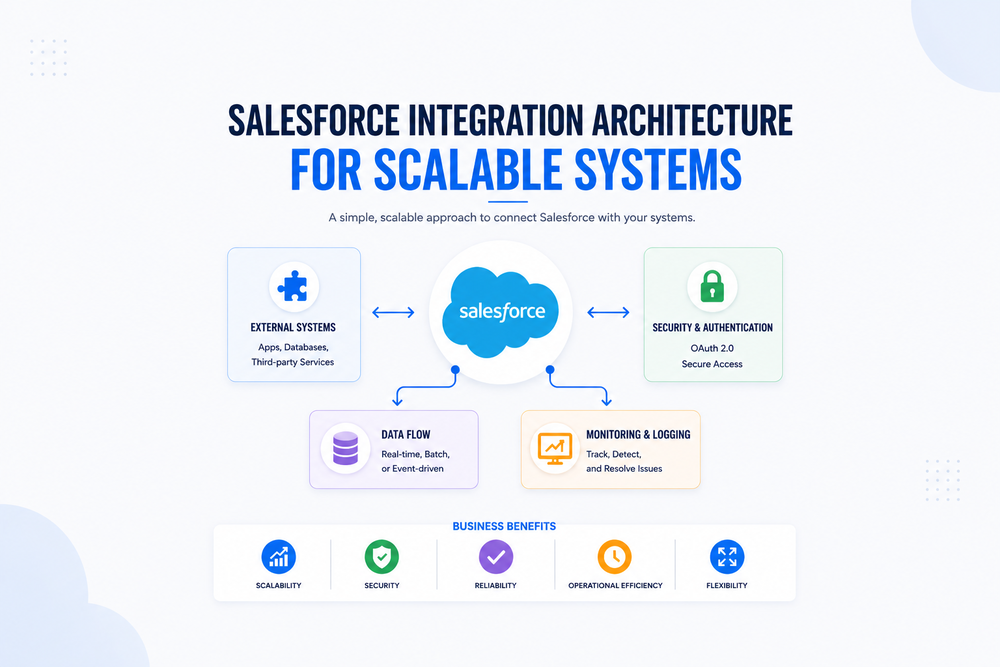
What Is Salesforce Integration Architecture and Why It Matters
Salesforce integration architecture is the design framework that determines how Salesforce interacts with other systems, applications, and services.
It includes:
- how APIs are designed and consumed
- how data flows between systems
- how authentication is managed
- how integrations scale and recover from errors
Unlike individual integrations, architecture focuses on the entire ecosystem, ensuring consistency and reliability across all connected systems.
Why Integration Architecture Matters for Scalable Systems
As systems grow, integration complexity increases. Without a proper architecture, even small issues can cause large-scale failures.
Common risks include:
- data inconsistencies across systems
- unstable integrations under load
- difficult troubleshooting and maintenance
- limited scalability
A well-designed integration architecture helps organizations scale without instability and ensures predictable behavior across environments.
Core Components of Salesforce Integration Architecture
A scalable architecture is built from several key components.
API Layer
Salesforce integrations rely heavily on APIs.
Best practices include:
- using REST APIs for flexibility
- designing an API-first approach
- minimizing unnecessary API calls
A well-designed API layer improves performance and scalability.
Official Salesforce integration patterns
Authentication and Security
Authentication is a critical part of any integration architecture.
Modern integrations should include:
- OAuth 2.0 authentication
- PKCE where required or recommended
- proper token lifecycle management
Learn more about updating authentication in this guide
Data Flow and Synchronization
Data flow defines how information moves between systems.
Key approaches include:
- real-time synchronization for critical operations
- batch processing for large data volumes
- event-driven architecture for scalability
Choosing the wrong model often leads to performance issues and data inconsistency.
Middleware and Integration Platforms
Middleware plays a critical role in scaling integrations.
It helps:
- decouple systems
- reduce point-to-point dependencies
- centralize integration logic
This is especially important in large Salesforce environments with multiple external systems.
Monitoring and Logging
Without monitoring, integration issues remain invisible until they affect business operations.
A mature architecture should include:
- real-time monitoring of API calls
- logging of integration events
- alerting for failures and anomalies
Common Salesforce Integration Architecture Mistakes
Many integration issues originate from architectural decisions.
Common mistakes include:
- point-to-point integrations without central control
- lack of centralized authentication
- missing monitoring and observability
- inconsistent environments across systems
These problems often lead to recurring failures and instability.
Learn more about common integration issues
Best Practices for Scalable Salesforce Integration Architecture
To build a scalable solution, organizations should follow proven principles.
Key best practices include:
- adopting an API-first design approach
- centralizing authentication and security
- using event-driven integration patterns
- designing for scalability from the start
- implementing proper error handling and retry logic
These practices reduce system fragility and improve long-term maintainability.
Integration Patterns in Salesforce
Different integration patterns are used depending on system requirements.
Common patterns include:
- request-response — real-time API communication
- batch integration — scheduled data processing
- event-driven integration — asynchronous and scalable
Selecting the right pattern is essential for performance and reliability.
Multi-System and Multi-Org Integration Challenges
Enterprise environments often include multiple systems and multiple Salesforce orgs.
Challenges include:
- maintaining data consistency across systems
- coordinating changes across environments
- managing integration dependencies
- enforcing governance and security
Without a structured architecture, these environments become difficult to manage.
How Integration Architecture Impacts DevOps and Releases
Integration design directly affects DevOps workflows and release processes.
In practice:
- integrations must be tested as part of deployments
- authentication flows must be stable across environments
- dependencies must be validated before release
Even when deployment succeeds, integrations may fail at runtime — architecture determines real stability.
Integration Architecture and Business Impact
Poor integration design does not just affect systems — it directly impacts business outcomes.
It can lead to:
- delayed operations
- incorrect reporting
- broken business processes
- reduced system trust
A strong architecture ensures reliability, predictability, and business continuity.
How Success Craft Designs Scalable Integration Architectures
At Success Craft, integration architecture is treated as a core part of system design, not just a technical layer.
Success Craft helps organizations:
- design integration architecture for complex Salesforce ecosystems
- manage multi-org and multi-system environments
- implement secure and scalable authentication models
- align architecture with DevOps and release processes
- ensure stability in real production environments
This approach allows organizations to move beyond isolated fixes and build systems that scale reliably over time.
Final Thoughts
A strong Salesforce integration architecture is the foundation of scalable and reliable systems. As integration complexity grows, architecture becomes the key factor that determines performance, stability, and long-term success.
Organizations that invest in proper architecture can scale confidently, while those that do not often face recurring failures and increasing technical debt.
In modern Salesforce environments, integration architecture is not optional — it is essential.
What is Salesforce integration architecture?
Salesforce integration architecture is the design of how Salesforce connects with other systems, including APIs, authentication, data flow, and scalability strategies.
Why is integration architecture important?
It ensures system stability, scalability, and consistent data flow across multiple systems.
What are common integration architecture mistakes?
Common mistakes include point-to-point integrations, lack of monitoring, inconsistent environments, and poor authentication design.
What is the best integration approach for Salesforce?
API-first and event-driven architectures are considered best practices for scalable systems.
Can Success Craft help design integration architecture?
Yes, Success Craft provides architecture design, audits, and optimization for Salesforce integrations.