

Salesforce Post-Deployment Operations: What Happens After CI/CD
Most Salesforce teams treat deployment as the final step of a release. Code is merged, metadata is deployed, tests pass, and the release pipeline finishes successfully. However, Salesforce post deployment operations often begin only after CI/CD has completed.
In practice, deployment does not automatically guarantee that production environments are operationally aligned. Layouts may need adjustment, permissions must be validated, integrations should reconnect correctly, and automation must behave as expected. These operational steps are essential to ensure that a release is not only technically deployed but also fully functional for users.
Salesforce post deployment processes help teams manage these operational changes and ensure stability across environments.
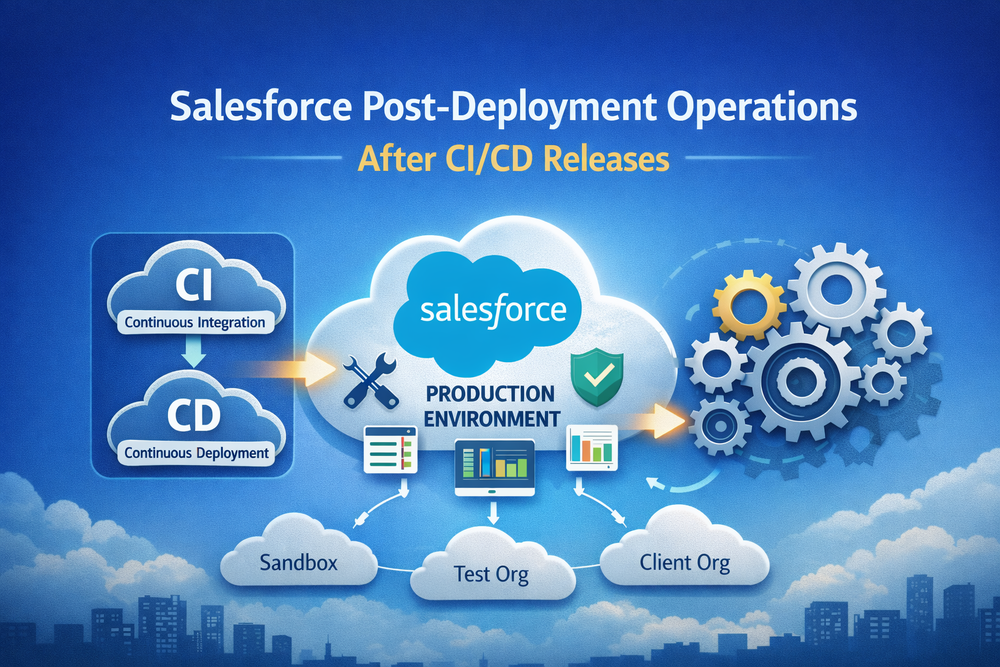
What Happens After a Salesforce Deployment
A Salesforce deployment moves metadata between environments. However, a successful deployment does not automatically mean that the system is ready for production use.
After deployment, teams often perform additional checks and operational adjustments such as:
- verifying page layouts and user interfaces
- confirming permission sets and access control
- validating automation and workflows
- synchronizing configuration across environments
- checking integrations with external systems
- running operational scripts when needed
These activities ensure that users experience a stable and predictable system after a release.
Why CI/CD Does Not Cover Salesforce Operational Changes
CI/CD pipelines are designed to automate the deployment of metadata and code. They support version control, testing, and controlled promotion between environments.
However, CI/CD does not always cover every operational change required after deployment. Salesforce environments often include subscriber-editable components, user-specific configurations, and operational scripts that must be handled separately from metadata deployment.
Because of this, many organizations introduce an additional operational layer after CI/CD that focuses on release validation, configuration alignment, and environment synchronization.
Common Post-Deployment Tasks in Salesforce
Updating Page Layouts and UI Elements
User-facing layouts often require synchronization after updates. Even when metadata changes are deployed successfully, layout assignments and UI adjustments may need additional validation.
Updating Picklist Values and Configuration
Configuration elements such as picklist values, field settings, or layout details may require updates to ensure that business workflows behave consistently.
Verifying Profiles and Permissions
Security settings must always be reviewed carefully. After deployment, teams often verify that user permissions and access rules align with the intended release design.
Running Operational Scripts
In some cases, operational scripts are executed to finalize deployment tasks or synchronize environments. These scripts can adjust configuration, align metadata, or prepare systems for user activity.
The Multi-Org Challenge
Post-deployment complexity increases significantly when organizations operate across multiple Salesforce environments.
Many companies manage:
- production orgs
- sandbox environments
- development environments
- partner or customer orgs
In these scenarios, maintaining consistency between environments becomes difficult. Configuration drift can occur when layouts, picklists, or permissions diverge across environments over time.
When only a few orgs exist, manual updates may still be manageable. But as the number of environments grows, operational coordination becomes increasingly complex.
Risks of Manual Post-Deployment Operations
Handling post-deployment tasks manually introduces several risks:
- configuration drift between environments
- inconsistent user experience across orgs
- security settings that do not match the release design
- delayed detection of release issues
- increased operational workload for administrators
Over time, these issues can slow down release cycles and increase support requests after deployments.
Automating Salesforce Post-Deployment Operations
To reduce operational risk, many organizations introduce automation for post-deployment processes. Instead of performing manual updates across environments, teams can standardize operational tasks and execute them in a controlled way.
Automated post-deployment operations can include:
- validating configuration before release activation
- synchronizing environments
- executing operational scripts across multiple orgs
- monitoring release activity
- generating execution logs and reports
This approach allows teams to move from manual release management to a more predictable operational model.
Automating Post-Deployment Workflows with ZuppIO
One platform designed specifically for these operational challenges is ZuppIO.
ZuppIO provides automation for post-deployment operations and multi-org coordination in Salesforce environments.
ZuppIO allows teams to:
- run operational actions across multiple Salesforce orgs
- synchronize configuration changes between environments
- validate updates before executing them
- execute operational scripts such as Apex across environments
- track execution history and deployment activity
These capabilities help organizations automate operational steps that traditionally occur after CI/CD pipelines finish.
How Success Craft Helps Manage Salesforce Releases
Successful Salesforce releases require both technical deployment and operational readiness. At Success Craft, release management is treated as a combination of architecture, DevOps strategy, and operational automation.
Success Craft helps organizations:
- design scalable Salesforce architectures
- implement DevOps and release management strategies
- automate operational workflows
- manage multi-org Salesforce environments
- integrate automation tools such as ZuppIO into release processes
Learn more about related services:
Salesforce consulting services
Final Thoughts
CI/CD is a critical component of modern Salesforce development, but it is not the final step of a successful release. After deployment, teams still need to validate environments, synchronize configurations, and ensure that users experience stable workflows.
Salesforce post deployment operations address these operational needs and help organizations bridge the gap between deployment and production readiness.
By combining DevOps pipelines with automated operational workflows, teams can reduce release risk, improve system consistency, and deliver more reliable Salesforce releases.
What are Salesforce post-deployment operations?
Salesforce post-deployment operations include the tasks performed after metadata deployment, such as configuration updates, permission validation, UI synchronization, and environment alignment. These activities ensure that the system operates correctly after a release.
Why is CI/CD not enough for Salesforce releases?
CI/CD pipelines focus on deploying code and metadata. They do not always manage operational configuration updates, environment synchronization, or manual adjustments required after deployment.
What problems can occur after Salesforce deployments?
Common issues include configuration drift, inconsistent layouts, permission mismatches, automation conflicts, and integration problems that appear only after users begin working in production.
How can Salesforce post-deployment operations be automated?
Automation tools such as ZuppIO allow teams to synchronize configuration, execute operational scripts, validate updates, and coordinate releases across multiple Salesforce environments.
Why are post-deployment processes important in Salesforce?
Without proper post-deployment processes, organizations risk inconsistent environments, operational errors, and reduced release reliability. Structured post-deployment operations help ensure stable and predictable Salesforce releases.