

Salesforce Trigger Best Practices for Scalable Enterprise Automation
Salesforce trigger best practices are essential for building scalable, maintainable, and operationally reliable Salesforce environments. As organizations expand their Salesforce ecosystems, automation complexity, transaction volume, and integration dependencies grow rapidly. Poorly designed triggers can eventually create recursive execution problems, governor limit failures, deployment instability, and difficult-to-maintain automation environments.
Triggers remain one of the core foundations of Salesforce automation because they provide:
- real-time business logic execution;
- scalable automation control;
- advanced transaction handling;
- integration orchestration;
- reusable enterprise logic.
However, enterprise Salesforce systems require much more than functional trigger code alone. Long-term scalability depends on:
- architecture discipline;
- governance standards;
- bulkification;
- observability;
- maintainability.
Without proper trigger architecture, organizations often encounter:
- recursive automation;
- performance bottlenecks;
- transaction instability;
- fragmented business logic;
- difficult debugging;
- operational complexity.
In many enterprise environments, trigger-related problems appear gradually. Automation ecosystems grow over time, additional Flows and integrations are introduced, and execution chains become increasingly difficult to predict and maintain.
In this guide, we explore:
- the most important Salesforce trigger best practices;
- scalable trigger architecture strategies;
- bulkification techniques;
- recursion prevention;
- governance and observability recommendations;
- common trigger mistakes;
- how enterprise teams build sustainable Salesforce automation environments.
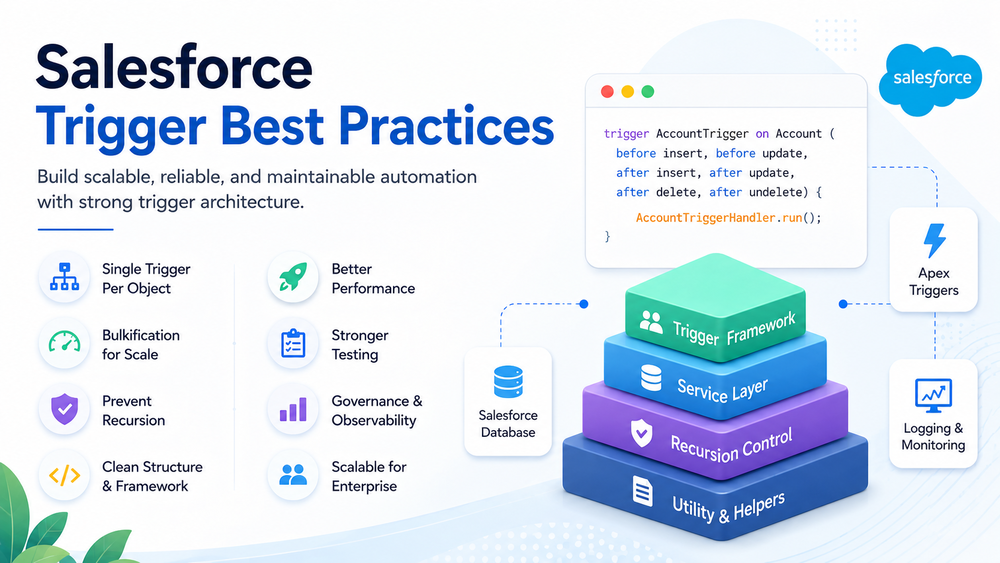
What Are Salesforce Triggers
Definition and Core Purpose
Salesforce triggers are Apex-based automation mechanisms that execute before or after specific database events occur.
Triggers allow organizations to implement:
- custom business logic;
- validation processes;
- automated updates;
- integration orchestration;
- transaction control.
Official Salesforce trigger documentation
Triggers can execute:
- before insert;
- before update;
- before delete;
- after insert;
- after update;
- after delete;
- after undelete.
Unlike declarative automation alone, triggers provide deeper control over transaction execution and enterprise-level business processes.
As Salesforce ecosystems become more interconnected, triggers often become responsible for coordinating automation across:
- multiple objects;
- external systems;
- asynchronous jobs;
- enterprise integrations.
Relationship Between Triggers, Flow, and Apex
Modern Salesforce environments frequently use both:
- declarative automation;
- programmatic automation.
Salesforce Flow is often ideal for:
- simple orchestration;
- guided automation;
- admin-managed processes.
Triggers are typically better suited for:
- complex business logic;
- reusable services;
- advanced integrations;
- high-volume processing;
- transaction-level control.
In enterprise environments, the most scalable approach is often a hybrid automation architecture where Flow and Apex work together rather than compete.
Related article:
Salesforce Flow vs Apex: When to Use Each Approach
Why Salesforce Trigger Best Practices Matter
Risks of Poor Trigger Design
Poorly designed triggers can create major operational challenges over time.
Organizations commonly encounter:
- recursive execution;
- governor limit failures;
- performance degradation;
- deployment instability;
- difficult troubleshooting;
- duplicated business logic.
Many trigger-related issues do not appear immediately. Small automation environments may initially work well, but as additional logic, integrations, and dependencies are added, transaction complexity grows significantly.
For example, one trigger may update a related object, which launches another automation chain that unexpectedly updates the original record again. In large Salesforce ecosystems, these recursive execution paths can become extremely difficult to debug.
Long-Term Impact on Enterprise Systems
Poor trigger architecture affects much more than code quality alone.
Over time, organizations may experience:
- slower release cycles;
- unstable deployments;
- fragmented automation;
- inconsistent governance;
- increasing technical debt.
As enterprise automation ecosystems expand, maintainability becomes just as important as functionality.
This is why Salesforce trigger best practices should be treated as long-term architecture requirements rather than simple coding guidelines.
Single Trigger Per Object Best Practice
Why Single Trigger Architecture Matters
One of the most widely accepted Salesforce trigger best practices is maintaining a single trigger per object.
This approach improves:
- maintainability;
- debugging;
- operational visibility;
- execution consistency;
- governance.
Single-trigger architecture helps organizations centralize automation logic and reduce execution unpredictability.
In enterprise environments, centralized trigger orchestration becomes increasingly important as multiple teams contribute to the same Salesforce ecosystem.
Problems With Multiple Triggers
Multiple triggers on the same object often create:
- unpredictable execution order;
- duplicated logic;
- recursion risks;
- difficult troubleshooting;
- fragmented automation governance.
As automation complexity increases, multi-trigger environments can quickly become difficult to maintain.
Many organizations eventually struggle to understand:
- which trigger executed first;
- why automation failed;
- where transaction instability originated.
Centralized trigger architecture significantly improves long-term maintainability.
Trigger Framework Best Practices
What Is a Trigger Framework
A trigger framework is a structured architecture approach that centralizes trigger orchestration and separates business logic from trigger execution itself.
Trigger frameworks typically provide:
- centralized execution handling;
- reusable services;
- modular architecture;
- cleaner transaction control.
Well-designed frameworks improve:
- scalability;
- maintainability;
- governance;
- testing.
Benefits of Trigger Frameworks
Trigger frameworks help organizations:
- simplify automation management;
- reduce duplicated logic;
- improve operational consistency;
- support scalable enterprise development.
As Salesforce ecosystems evolve, trigger frameworks become increasingly valuable for maintaining architectural discipline across multiple development teams.
In enterprise environments, scalable governance is often impossible without centralized trigger architecture standards.
Prevent Recursive Trigger Execution
Common Recursion Problems
Recursive automation is one of the most common trigger-related issues in Salesforce.
Typical recursion scenarios include:
- self-updating records;
- cross-object automation loops;
- chained trigger execution;
- Flow and Apex interaction conflicts.
For example:
- a trigger updates a related object;
- another automation reacts to that update;
- downstream logic updates the original object again.
Over time, these recursive execution chains can create severe transaction instability.
How to Prevent Recursion
Organizations commonly use:
- static variables;
- execution guards;
- centralized trigger orchestration;
- transaction state management.
Preventing recursion significantly improves:
- scalability;
- debugging;
- operational reliability;
- transaction predictability.
Without recursion controls, enterprise automation environments can become highly unstable as complexity grows.
Bulkification Best Practices for Triggers
Why Bulkification Is Critical
Bulkification is one of the most important Salesforce trigger best practices.
Salesforce processes records in batches rather than individually. Trigger logic that assumes single-record processing often fails in production environments with large transaction volume.
Without proper bulkification, organizations may encounter:
- SOQL limit failures;
- excessive DML operations;
- poor scalability;
- transaction instability.
Enterprise automation must always be designed for multi-record execution.
Avoid SOQL Queries Inside Loops
One of the most common Apex anti-patterns is placing SOQL queries inside loops.
This approach significantly increases:
- governor limit consumption;
- transaction complexity;
- performance risks.
Organizations should instead:
- query records in bulk;
- use collections efficiently;
- minimize database operations.
Efficient query architecture improves both scalability and operational reliability.
Avoid DML Operations Inside Loops
DML operations inside loops can quickly consume governor limits.
For example, updating records individually may work in testing environments but fail in production when hundreds of records are processed simultaneously.
Organizations should:
- batch updates together;
- reduce unnecessary DML operations;
- optimize transaction handling.
This significantly improves:
- performance;
- scalability;
- deployment reliability.
Keep Triggers Thin
Separate Business Logic From Triggers
Triggers should remain lightweight and focused on orchestration rather than complex business processing.
Organizations should move business logic into:
- service layers;
- reusable classes;
- dedicated processing components.
This approach improves:
- maintainability;
- scalability;
- testing efficiency;
- governance.
Thin triggers are significantly easier to support and evolve over time.
Improve Scalability With Modular Architecture
Modular architecture allows organizations to:
- centralize business logic;
- reduce duplication;
- improve observability;
- simplify deployment management.
As enterprise environments grow, modular trigger architecture becomes increasingly important for maintaining operational stability.
Trigger Performance Optimization
Reduce Transaction Complexity
Complex transactions are one of the biggest causes of trigger instability.
Organizations should:
- reduce nested automation;
- minimize execution chains;
- simplify orchestration;
- avoid unnecessary updates.
Reducing transaction complexity improves:
- performance;
- debugging;
- operational reliability;
- deployment stability.
Optimize Query Performance
Organizations should focus on:
- selective queries;
- indexed fields;
- efficient filtering;
- minimizing unnecessary data retrieval.
As transaction volume grows, query optimization becomes critical for maintaining scalable enterprise performance.
Trigger Testing Best Practices
Write Meaningful Unit Tests
Testing should validate:
- bulk processing scenarios;
- recursion prevention;
- edge cases;
- integration behavior;
- error handling.
Strong testing improves:
- deployment reliability;
- scalability;
- long-term maintainability.
Testing should not only satisfy deployment requirements. It should also improve operational confidence in enterprise release processes.
Improve Deployment Stability
Enterprise Salesforce environments require:
- CI/CD pipelines;
- automated validation;
- regression prevention;
- release governance.
Stable trigger architecture significantly reduces deployment risk in large Salesforce ecosystems.
Trigger Governance Best Practices
Standardize Architecture
Organizations should maintain:
- naming conventions;
- documentation standards;
- code review processes;
- architecture governance.
Without governance, automation ecosystems often become fragmented and difficult to maintain.
Improve Observability
Enterprise automation environments require visibility into:
- transaction failures;
- recursion issues;
- governor limit usage;
- integration behavior;
- execution bottlenecks.
Common observability practices include:
- centralized logging;
- transaction tracing;
- exception monitoring;
- async job visibility;
- integration alerts.
Without observability, enterprise trigger environments become difficult to troubleshoot reliably.
Common Salesforce Trigger Mistakes
Overcomplicated Trigger Logic
Overengineering often creates:
- difficult maintenance;
- governance problems;
- operational confusion;
- scalability risks.
Organizations should prioritize clarity and modularity over unnecessary complexity.
Hardcoded Business Rules
Hardcoded IDs and environment-specific logic create:
- deployment instability;
- scalability limitations;
- governance challenges.
Reusable configuration-based architecture is significantly more maintainable.
Lack of Governance
Without architecture standards, organizations often accumulate:
- duplicated logic;
- inconsistent naming conventions;
- fragmented automation;
- operational instability.
Governance becomes increasingly important as automation ecosystems scale.
How Success Craft Builds Scalable Salesforce Automation
Success Craft helps organizations build scalable Salesforce automation architectures designed for long-term operational reliability.
Our expertise includes:
- Apex trigger optimization;
- enterprise automation architecture;
- governance strategies;
- transaction optimization;
- observability improvements;
- scalable Flow + Apex automation design.
We help businesses:
- reduce automation complexity;
- stabilize enterprise automation;
- improve deployment reliability;
- optimize Salesforce performance;
- modernize automation architecture.
Many organizations initially focus on delivering automation quickly but later encounter scalability and maintenance problems as their environments evolve. Success Craft helps companies build Salesforce ecosystems that remain scalable, maintainable, observable, and operationally stable over time.
Related services:
Final Thoughts
Following Salesforce trigger best practices is essential for building scalable Salesforce environments that remain stable as automation complexity grows.
Enterprise automation requires much more than functional trigger code alone. Long-term success depends on:
- governance;
- scalability;
- maintainability;
- observability;
- operational reliability.
As Salesforce ecosystems evolve, architecture quality becomes increasingly important.
Well-designed trigger architecture helps organizations:
- improve scalability;
- reduce operational risk;
- stabilize deployments;
- simplify maintenance;
- support long-term business growth.
In modern enterprise environments, scalable Salesforce automation is not only about writing trigger logic. It is about building sustainable operational architecture capable of supporting complex enterprise ecosystems over time.
What are Salesforce trigger best practices?
Salesforce trigger best practices include bulkification, single trigger per object architecture, recursion prevention, modular design, and scalable transaction management.
Why should you use one trigger per object?
Using one trigger per object improves maintainability, governance, execution consistency, and debugging visibility in enterprise Salesforce environments.
How do you prevent recursive triggers in Salesforce?
Organizations typically prevent recursion using static variables, execution guards, centralized trigger frameworks, and transaction state management.
What is a Salesforce trigger framework?
A Salesforce trigger framework is a structured architecture approach that centralizes trigger execution and separates business logic from orchestration logic.
How do you optimize Salesforce trigger performance?
Organizations optimize trigger performance by bulkifying logic, reducing transaction complexity, minimizing SOQL and DML operations, and improving query efficiency.